3D Printing Filament Cheat Sheet
One page that covers the seven filaments most people actually print: what each one is good at, the temperatures to start from, whether you need an enclosure or a dryer, and the failure mode that catches people out. Print it and tape it to the wall, or read the same data as a table below.
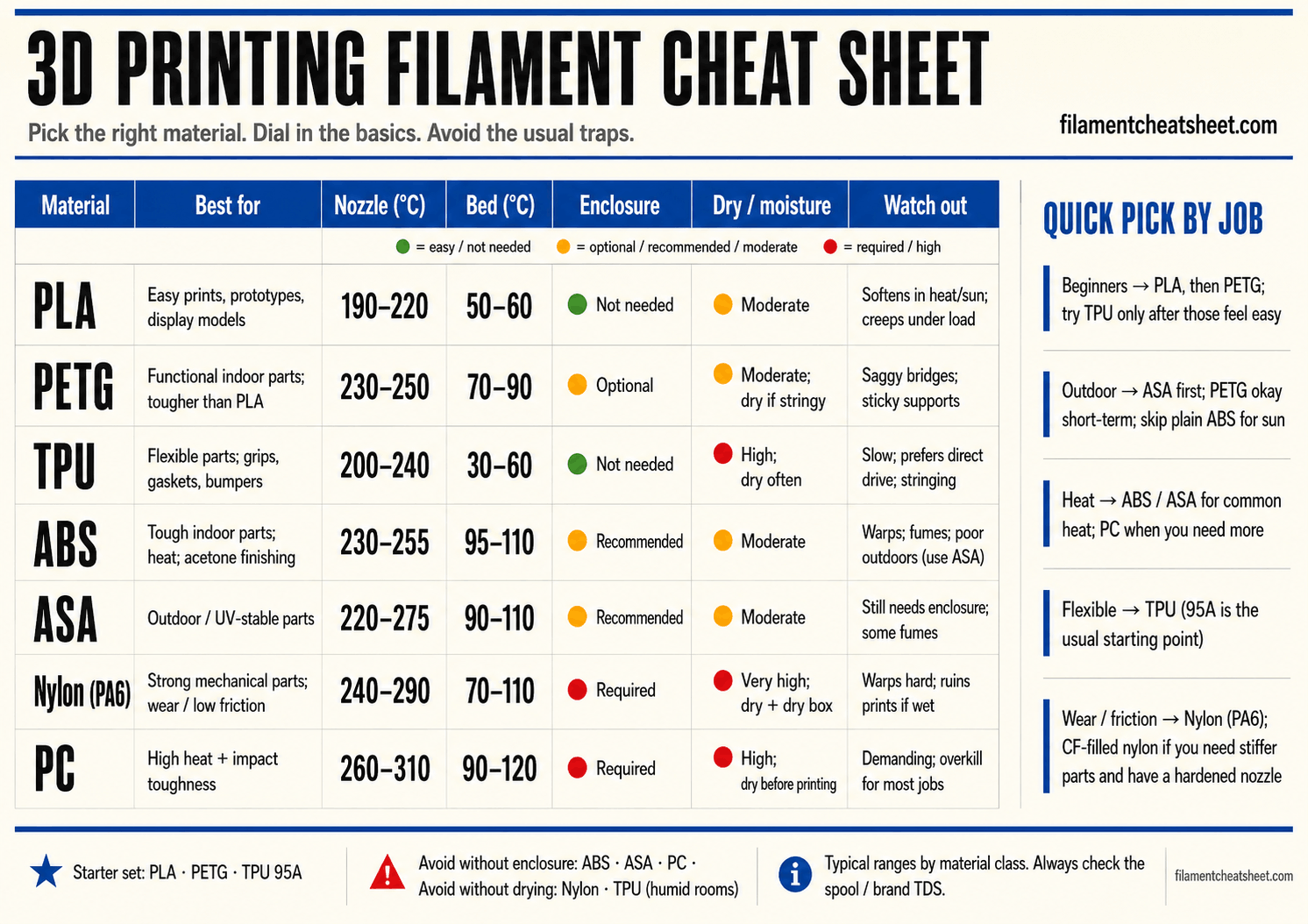
Filament cheat sheet table
Same data as the printable sheet. Tap a material for the full guide with brand picks, tuning tips, and common problems.
| Material | Best for | Nozzle (°C) | Bed (°C) | Enclosure | Dry / moisture | Watch out |
|---|---|---|---|---|---|---|
| PLA | Easy prints, prototypes, display models | 190-220 | 50-60 | Not needed | Moderate | Softens in heat/sun; creeps under load |
| PETG | Functional indoor parts; tougher than PLA | 230-250 | 70-90 | Optional | Moderate; dry if stringy | Saggy bridges; sticky supports |
| TPU | Flexible parts; grips, gaskets, bumpers | 200-240 | 30-60 | Not needed | High; dry often | Slow; prefers direct drive; stringing |
| ABS | Tough indoor parts; heat; acetone finishing | 230-255 | 95-110 | Recommended | Moderate | Warps; fumes; poor outdoors (use ASA) |
| ASA | Outdoor / UV-stable parts | 220-275 | 90-110 | Recommended | Moderate | Still needs enclosure; some fumes |
| Nylon (PA6) | Strong mechanical parts; wear / low friction | 240-290 | 70-110 | Required | Very high; dry + dry box | Warps hard; ruins prints if wet |
| PC | High heat + impact toughness | 260-310 | 90-120 | Required | High; dry before printing | Demanding; overkill for most jobs |
Typical ranges by material class, not a specific spool. Always check the brand's technical data sheet and tune with a temperature tower. High-temp materials need ventilation in addition to an enclosure.
Quick pick by job
Beginners
PLA, then PETG; try TPU only after those feel easy
Outdoor
ASA first; PETG okay short-term; skip plain ABS for sun
Heat
ABS / ASA for common heat; PC when you need more
Flexible
TPU (95A is the usual starting point)
Wear / friction
Nylon (PA6); CF-filled nylon if you need stiffer parts and have a hardened nozzle
Starter set
PLA, PETG, and TPU 95A cover most of what a new printer gets asked to do. Get those printing well before spending money on anything else.
Avoid without an enclosure
ABS, ASA, and PC. They warp and delaminate in open air, and they need ventilation as well as heat retention.
Avoid without drying
Nylon always, and TPU in humid rooms. Wet filament pops, strings, and prints weak parts no amount of tuning will fix.
Full guide for each material
Cheat sheet FAQ
Is the filament cheat sheet free to download and print?
Yes. The cheat sheet is a free PNG sized for an 11x17 print, and it also works fine scaled down to letter or A4. Download it, print it, and pin it next to your printer.
What temperatures does the cheat sheet list for each filament?
PLA 190-220C nozzle / 50-60C bed, PETG 230-250C / 70-90C, TPU 200-240C / 30-60C, ABS 230-255C / 95-110C, ASA 220-275C / 90-110C, Nylon PA6 240-290C / 70-110C, and PC 260-310C / 90-120C. These are typical ranges for the material class, not a specific spool.
Which filaments on the cheat sheet need an enclosure?
Nylon and PC need an enclosure, ABS and ASA are strongly better with one, PETG is optional, and PLA and TPU do not need one. High-temp materials also need ventilation, not just an enclosure.
Which filaments have to be dried before printing?
Nylon needs drying and a dry box every time, TPU and PC should be dried before use, and PLA, PETG, ABS, and ASA only need drying if they have been sitting out or start stringing.