Filament Trends to Watch in 2026: Better PETG, Refill Spools, Smart Tags, and Next-Gen Additives
What is actually changing in filament right now, and what it means for print speed, reliability, waste reduction, and material selection.
Josh Holtzclaw
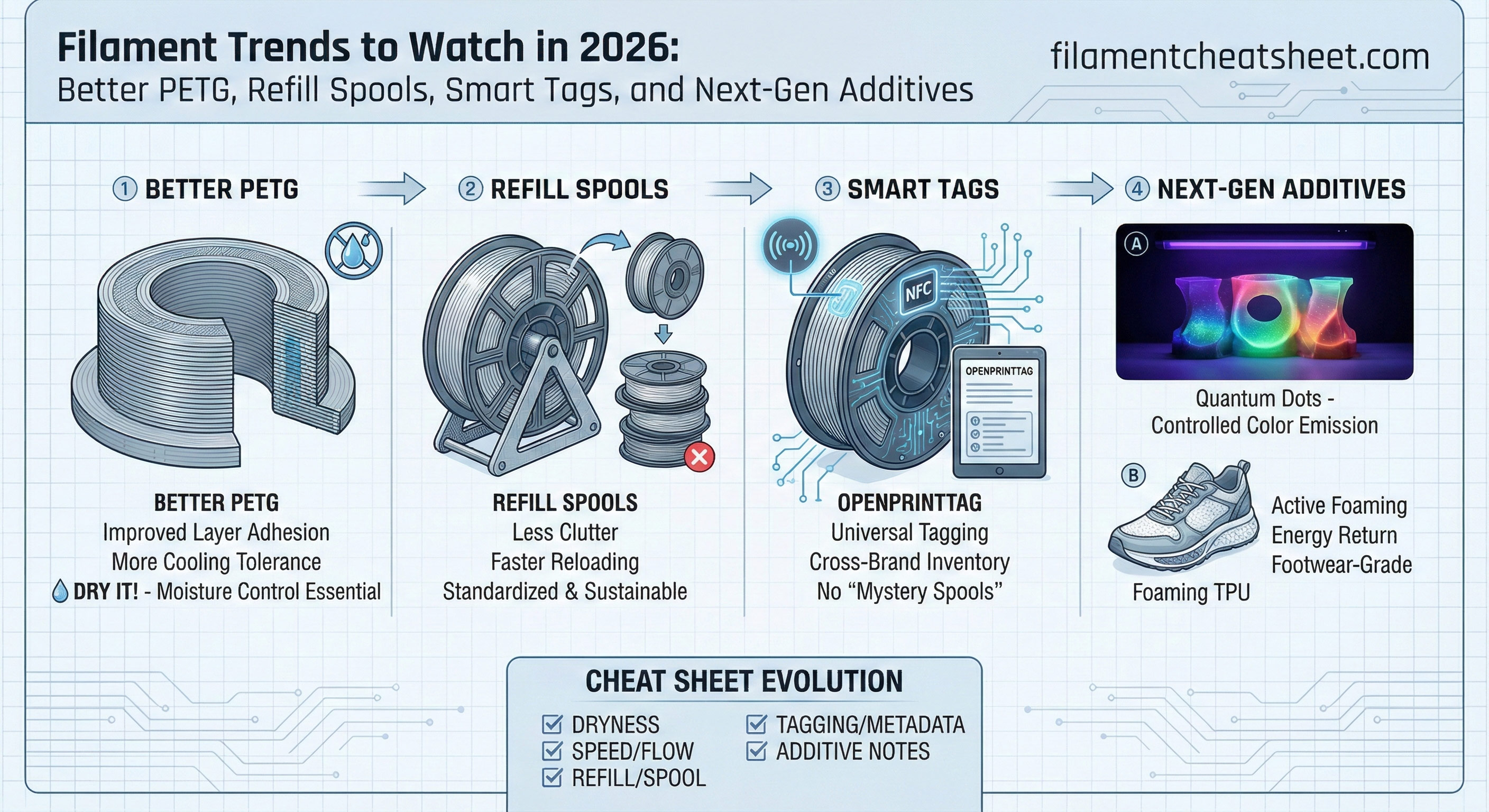
Filament innovation in 2026 is less about yet another colorway and more about fixing the real friction in day-to-day printing: speed without failures, simpler spool management, and materials that behave predictably across different printers.
Below are four trends worth tracking if you care about filament choices and print reliability, plus practical moves you can make this week to benefit from them.
"Better PETG" Is Becoming a Real Category#
PETG has always been a favorite for functional prints, but it is also the filament many people have a love-hate relationship with. It is tougher than PLA and often less brittle, but classic PETG can string, ooze, and become inconsistent fast when it is even slightly wet.
What is changing is that manufacturers are releasing PETG formulas that explicitly target improved layer adhesion and print quality, and they are being unusually direct about moisture sensitivity.
Polymaker's documentation for its newer PETG formula calls out massively increased layer adhesion (enabling more cooling fan than their PolyLite PETG) and emphasizes that the filament prints much nicer when dry and is fairly hygroscopic. It even suggests drying if you hear popping or cracking while extruding.
Why this matters:
- Better layer adhesion moves PETG from "sometimes strong" to more consistently strong, especially for parts that fail along layer lines
- If the material tolerates more cooling, you can often get cleaner overhangs and bridges without sacrificing strength as easily
- Stronger "dry it" guidance is basically a signal that moisture control is becoming a baseline part of a serious PETG workflow
Want a deeper dive on high-flow PETG specifically? Check out our article on PETG HF and high-speed filaments.
Quick PETG Refresh Checklist#
- Dry the spool if you see zits, random roughness, or hear popping
- If you are chasing stringing, confirm dryness before you touch retraction
- If your parts snap along layers, prioritize adhesion first (temperature and cooling balance) before changing infill patterns
Refill Spools Are Going Mainstream#
Refills used to be a niche move. Now they are increasingly marketed as a normal way to buy filament, especially for people running multi-spool systems and anyone sick of storing bulky empty spools.
Polymaker's Panchroma PLA refill is positioned as a low-waste format designed for refill-compatible spool systems, with explicit mention of compatibility with reusable and multi-spool systems (including AMS-style systems). Polymaker also published a launch post framing refills as a way to use a reusable master spool while reducing waste and cutting costs.
Why refills matter even if you are not printing "green" on purpose:
- Less clutter — fewer rigid spools stacked everywhere
- Faster reloading when you standardize on a couple reusable masters
- Potential cost savings if the brand passes shipping efficiency through
Practical Tip#
If you print a lot of the same material, pick one "daily driver" (PLA or PETG) and standardize that on refills. Keep 2-3 reusable spools labeled and ready, and you will feel the convenience immediately.
Smart Spools Are Getting Less Proprietary#
Smart spool tags are useful when they reduce friction: you load a spool and the system knows what it is. The problem has been fragmentation — each ecosystem tends to use its own tag format, which reinforces lock-in.
OpenPrintTag is an open-source NFC tag standard designed to work across brands and ecosystems. Prusa has been shipping it with redesigned Prusament spools, and Prusa's own write-up highlights that the tag is open and reusable. Their knowledge base also says that every Prusament spool manufactured since October 2025 includes OpenPrintTag.
What is interesting is that software platforms are also documenting support. SimplyPrint, for example, states it fully supports OpenPrintTag, positioning it as a future-proof NFC format for spools.
Why this matters:
- Universal tagging reduces "mystery spool" errors and bad presets
- It opens the door for truly cross-brand filament inventory tooling
- It makes spool management feel closer to a workflow feature, not a brand feature
Start Tracking These Fields Now#
Even if you never touch an NFC tag, adopt the same data mindset:
- Material and brand
- Color name
- Dry status — dry / unknown / needs drying
- Nozzle temp range, bed temp range
- Max flow notes — even informal: low/med/high
- Nozzle type — brass ok vs hardened recommended
That structure will future-proof your inventory and make it easier to migrate to tagging later.
Additives Are Getting More Ambitious#
Two recent examples show how much the "filament news" category is expanding.
Quantum Dot Filament Is Not Just a Novelty Color#
ProtoPasta published a press post about Quantum Dot Filament debuting at CES 2026 in collaboration with Quantum Light, framing it as a way to 3D print with quantum dot effects. 3D Printing Industry also covered the material, describing it as incorporating semiconductor nanocrystals into a thermoplastic filament and enabling controlled color emission under UV light.
We covered this in more detail in our article on filament color tech and quantum dots.
Footwear-Grade TPU Is Turning Into Its Own Product Lane#
Siraya Tech introduced Roamr and TPU Air HR as a material developed for 3D printed footwear. Coverage describes it as targeting comfort and rebound tradeoffs. Siraya Tech's own product pages for 85A and 80A variants highlight active foaming and energy return claims, positioning it as higher rebound and less mushy compared to prior TPU approaches.
The Takeaway: Your Filament Cheat Sheet Should Evolve#
In 2026, the best cheat sheets are not just temperature charts. They capture workflow reality:
- Dryness sensitivity and symptoms when wet
- Speed and max flow expectations
- Refill vs spool compatibility notes
- Tagging and metadata fields (even if manual)
- Additive-specific notes — UV-reactive, foaming, abrasive, etc.
A Simple New Spool Intake Routine#
- Label it: material, brand, date opened
- Decide dry status: dry it now or mark as unknown
- Print a quick baseline: a small cube or calibration strip
- Record 3 notes: best temp window, retraction behavior, surface finish
Do this consistently and you will save hours over a month, especially if you print across multiple materials and brands.
Related Articles

OpenPrintTag: The Open-Source Smart Spool Standard That Could De-Fragment Filament Metadata
OpenPrintTag is an open NFC standard for filament data designed to work across brands and stay offline. Here is why it matters and how it could change spool management.
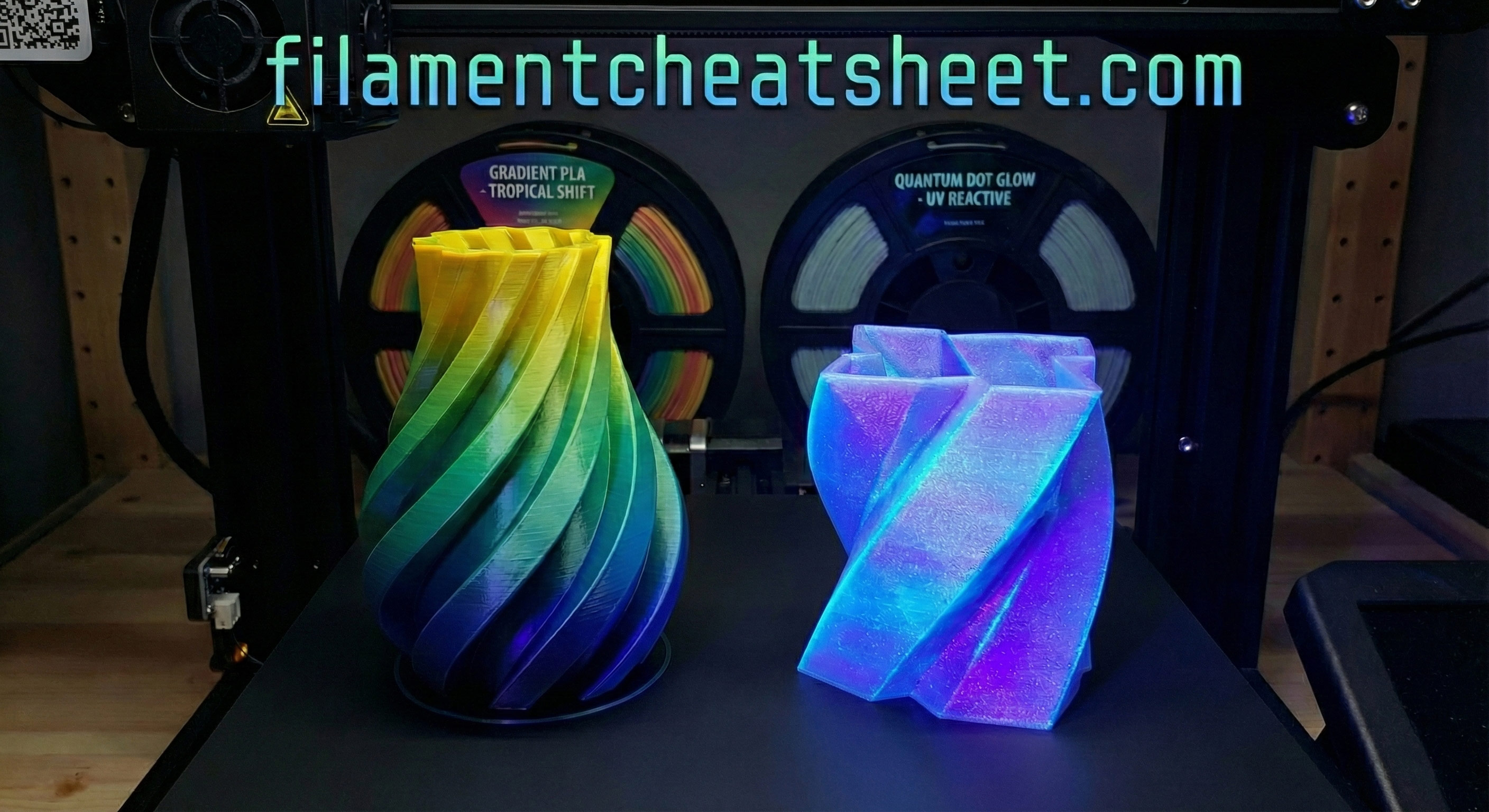
Filament Color Tech Gets Wild: Quantum Dots, Gradient PLA, and What Comes Next
From quantum dot glow effects to curated gradient PLA launches, color science is becoming a real filament battleground.
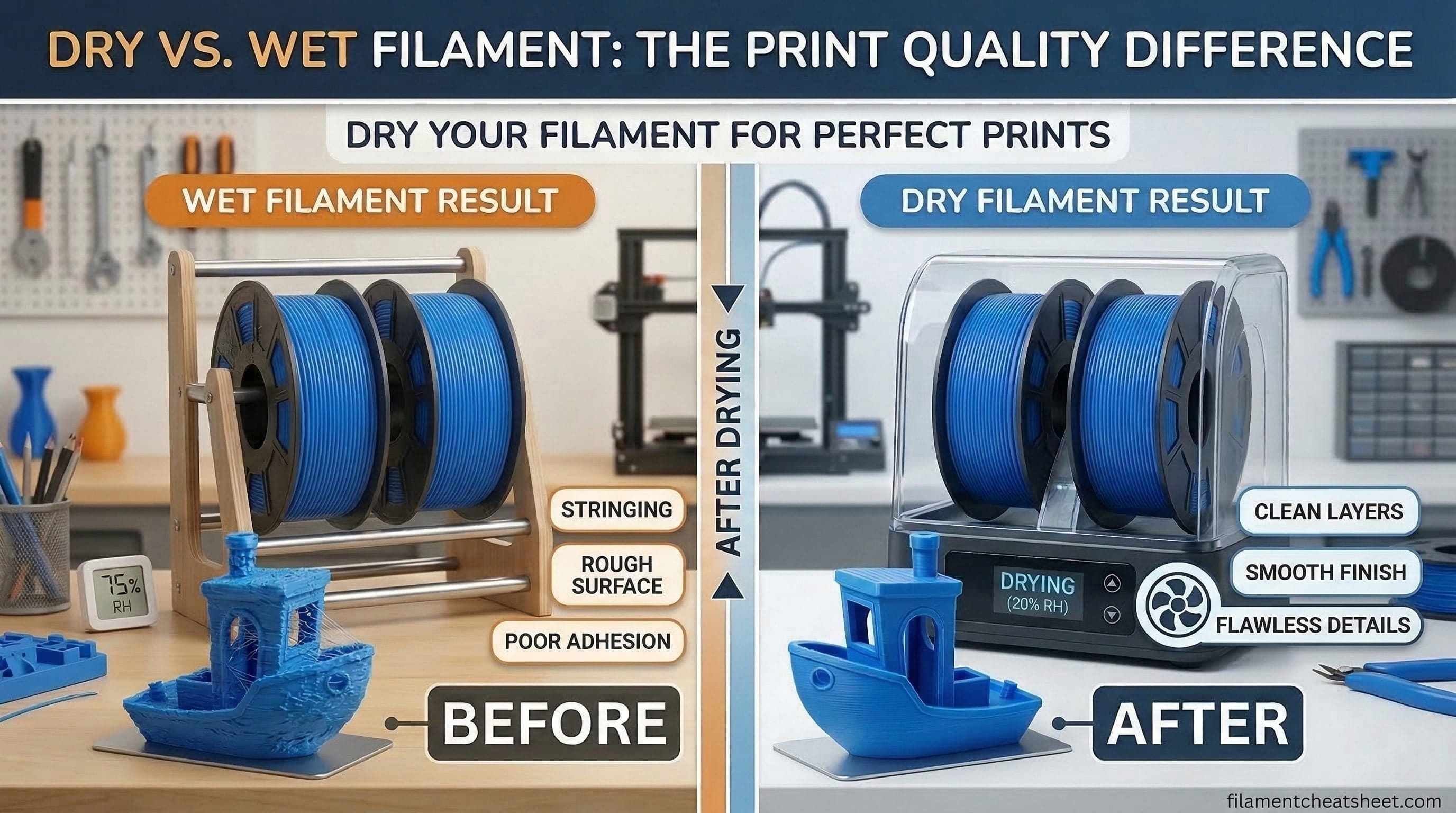
How to Dry and Store 3D Printing Filament (So It Stops Ruining Your Prints)
A practical guide to filament moisture — how to spot it, how to fix it, and how to keep every spool dry long-term with the right storage and drying setup.