Is Bambu PLA Pure Food Safe? What the Certification Covers
Bambu PLA Pure is certified under EU 10/2011 for food contact, but that certifies the filament, not your printed part. What the certification covers, and where the real risk is.
Josh Holtzclaw
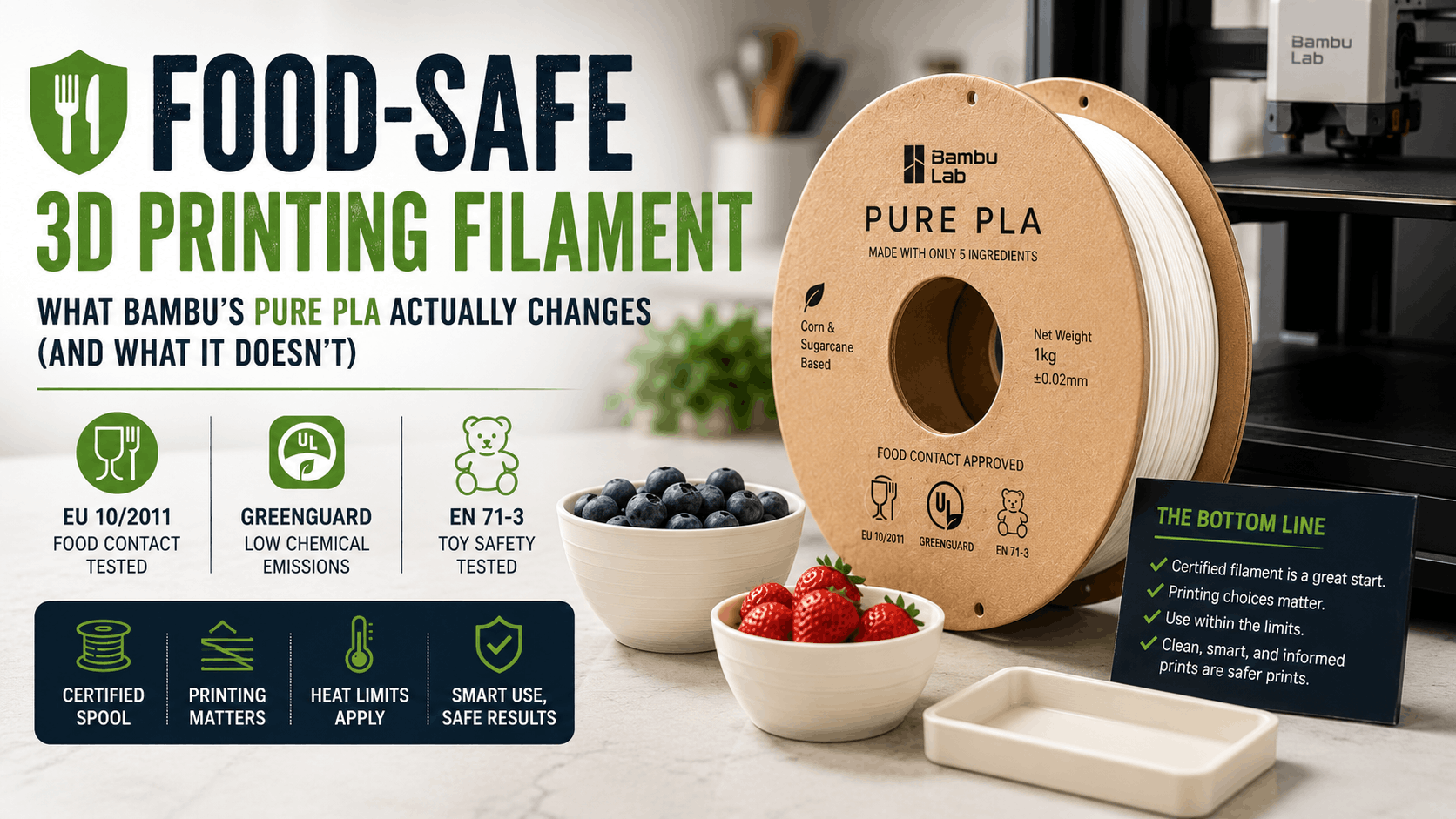
Update (June 2026): Bambu PLA Pure is now available internationally, including the US, EU, UK, Canada, and Australia. The original "wait for international availability" guidance below has been corrected. Check your regional Bambu store for current pricing and stock.
Bambu Lab launched PLA Pure earlier this year, and unlike the usual "food safe" filament marketing, this one comes with actual third-party certification under EU Regulation 10/2011 (food-contact plastics), UL GREENGUARD (indoor emissions), and EN 71-3 (toy safety). It is one of the cleanest filament launches in years on the safety side, and it has put "food safe filament" back into hobbyist conversation.
The problem is that "food safe filament" is not the same thing as "food safe 3D printed part." Most of the marketing you see on Amazon for food-safe spools is technically accurate but practically misleading. This guide walks through what PLA Pure actually brings to the table, what "food contact certified" really means, and why even the cleanest filament has hard limits in real-world food use.
What Bambu's PLA Pure Actually Brings to the Table#
Bambu kept the formulation deliberately short. According to the Bambu Lab PLA Pure wiki, the material is made from only five ingredients:
- PLA (from corn and sugarcane)
- Acrylate copolymer
- Colorant pigments
- Ethylene bisstearamide
- Talc (asbestos-free)
That short list matters because each ingredient was selected to pass three concrete tests, not to chase a vague marketing claim:
- EU Regulation 10/2011 for plastic food contact. Migration tests run at 70°C for 2 hours into food-simulant solutions, with substance migration kept below regulatory limits.
- UL GREENGUARD for indoor air emissions, evaluated against the UL 2904 standard developed specifically for FDM 3D printing.
- EN 71-3 for toy safety, covering heavy-metal migration (lead, cadmium, mercury, and similar).
This is unusually rigorous for a hobbyist-grade spool. Most "food safe" marketing relies on the resin pellet supplier's food-grade status, not on a tested finished product.
As of mid-2026, PLA Pure is available internationally (US, EU, UK, Canada, and Australia), not just in China. Pricing and stock vary by region, so check your regional Bambu store for the current price and availability before buying.
Why "Food Safe Filament" Is Usually Misleading#
Even with a certified spool, the printed part has problems the resin certification cannot fix.
The Spool Is Not the Whole Story#
Food-grade PLA resin becomes a food-grade part only if the printing process does not introduce contamination. In FDM printing, three things actively work against you:
- Layer lines are microscopic crevices. They trap food residue, become very hard to fully clean, and harbor bacterial growth on anything you reuse.
- Print bed surfaces (PEI, glass with glue, textured plates) can transfer residues. PEI in particular can leach low levels of additives, and glue-stick adhesion residues are not food-rated.
- Color pigments in general-purpose PLA are not always migration-tested. A "food safe" base resin in a non-tested color is no longer a food-safe finished product.
Nozzle Contamination Is Real#
The nozzle is in direct contact with your filament at extrusion temperature. Common nozzle materials include lead-bearing alloys that can leach into printed parts:
- Brass nozzles (the default on most printers) can contain small amounts of lead. The 2017 RoHS-compliant variants are better, but not all replacement nozzles you buy on Amazon are RoHS-compliant.
- Stainless steel nozzles are the safer default for any food-contact print. Hardened steel for carbon fiber and abrasive composites is fine too.
If you are serious about food-contact printing, swap to a stainless or hardened-steel nozzle and dedicate it to clean materials. Cross-contamination from previous prints (especially anything with carbon fiber, metal fill, or unknown additives) is a real concern.
Heat Limits Tank Most Use Cases#
PLA, including PLA Pure, softens around 60°C. Any actually hot food, dishwasher cycle, or even a sunny windowsill in summer can deform a printed part. Bambu explicitly recommends keeping PLA Pure prints in the 0 to 60°C range and avoiding acidic, alkaline, or oily contact.
That rules out most reusable kitchenware. PLA Pure is great for cookie cutters used once, chocolate molds used cold, and ice cube trays. It is not great for anything that lives in a dishwasher, holds warm food, or contacts citrus, tomato sauce, or vinegar dressings.
What "Food Contact Certified" Actually Means#
A few terms get thrown around interchangeably. They are not the same.
- EU Regulation 10/2011 is the European standard for plastic materials and articles intended to contact food. It sets specific migration limits for hundreds of substances. Compliance is product-specific, meaning a certified material in one color may not be certified in another.
- FDA 21 CFR 177 is the US equivalent. Most virgin PLA resins qualify as "FDA compliant" at the resin level, but that does not certify a finished 3D printed part. There is no FDA certification for FDM-printed objects as a category.
- GREENGUARD is about indoor air emissions while printing, not food contact. A GREENGUARD-certified filament is safer to print in a home environment but tells you nothing about post-print food safety.
- EN 71-3 is the European toy safety heavy-metals standard. Useful proxy for "no nasty pigments" but not a food-contact certification on its own.
When a brand says "food safe," look for the EU 10/2011 reference specifically. Anything vaguer is marketing.
The Brands and Materials Actually Worth Considering#
Realistically, the food-contact certified hobbyist filament list is short.
- Bambu Lab PLA Pure is the most credible mainstream option, now available internationally. Real certification, conservative formulation, sensible documentation.
- Fillamentum has historically offered food-safe variants in its HIPS line. Worth checking current product pages because formulations change over time.
- Polymaker publishes detailed material datasheets and is the most reliable source for "is this resin food-grade at the pellet level" questions, even when the finished product does not carry full certification.
- Prusament has explicitly stated that some pigments in their PLA and PETG use inorganic non-migratory colorants, but they have not pursued formal food-contact certification.
Most generic "food safe" labels on Amazon listings are functionally meaningless. If the listing does not name a specific certification standard, treat it as ordinary PLA for safety purposes.
Tip: a food-grade pellet does not equal a food-grade printed part. The certification you want is at the finished material level, ideally EU 10/2011 for plastics or an equivalent regional standard.
Practical Reality Check: What You Can Actually Print for Food Contact#
A practical decision tree, assuming you are using a certified or strongly-pedigreed PLA:
- Single-use, cold-only: cookie cutters, ice cube trays, garnish stamps, cake-decorating stencils. Probably fine. Discard or recycle after one use.
- Reusable, cold-only: cold-food molds (chocolate, fondant, jello). Use with caution. Layer lines trap residue and can harbor bacteria even with careful cleaning, and brass nozzles, non-food-grade pigments, and any coatings or post-processing add their own risks. If you do reuse a printed mold, keep it to a single ingredient, hand-clean only (no dishwasher), avoid sealants that are not food-rated, and replace it often. For anything you want to reuse properly, cast it in food-grade silicone from a printed master so the print never touches food.
- Anything warm or wet: not recommended. Heat, moisture, and cleaning cycles all degrade the print and increase migration.
- Anything dishwasher-cleaned: hard no. The combination of heat, detergent, and pressure water both deforms PLA and forces water into layer lines.
For anything beyond the "single-use, cold-only" category, the right answer is usually to print a master pattern and cast the actual food-contact object in food-grade silicone. The print never touches food, and silicone is genuinely dishwasher-safe.
What This Means for Your Buying Decisions#
Some pragmatic guidance for the next 6 to 12 months:
- If you actually print for food contact, PLA Pure is now available internationally, or you can buy a Fillamentum food-grade variant. Do not pay a premium for generic "food safe" Amazon listings.
- Keep a dedicated stainless or hardened-steel nozzle for clean prints. The nozzle itself is part of the contamination story.
- Document your build environment. If you print food-contact parts, knowing which roll, which color, which nozzle, and which bed surface a piece came off helps a lot if something behaves unexpectedly.
- Treat any "food safe" marketing claim with skepticism unless the brand publishes the specific certification standard and test conditions.
Food-safe filament marketing has been a quiet mess for years. Bambu PLA Pure is the first widely-distributed product that earns the label honestly, and it raises the bar for everyone else. Expect Polymaker, Prusament, and other premium brands to follow with certified options of their own through 2026 and 2027.
For deeper material context, see the PLA filament guide, the getting started with PLA beginner article, and the broader filament chemistry pressures shaping reformulations across the industry. Browse the full filament brand directory for per-brand notes when comparing options.
Related Articles
Best 3D Printers for Every Budget in 2026: Under $300, $500 and $1,000
The printers worth buying at each price, with current prices, honest trade-offs, and what each one can and can't print. From a $199 first printer to enclosed multicolor machines.
Best Budget Multicolor 3D Printers in 2026 (and What They Waste)
Four-color printing now starts at $279. Which multicolor printers are worth buying, how the different systems work, and the purge waste and print time nobody puts on the box.
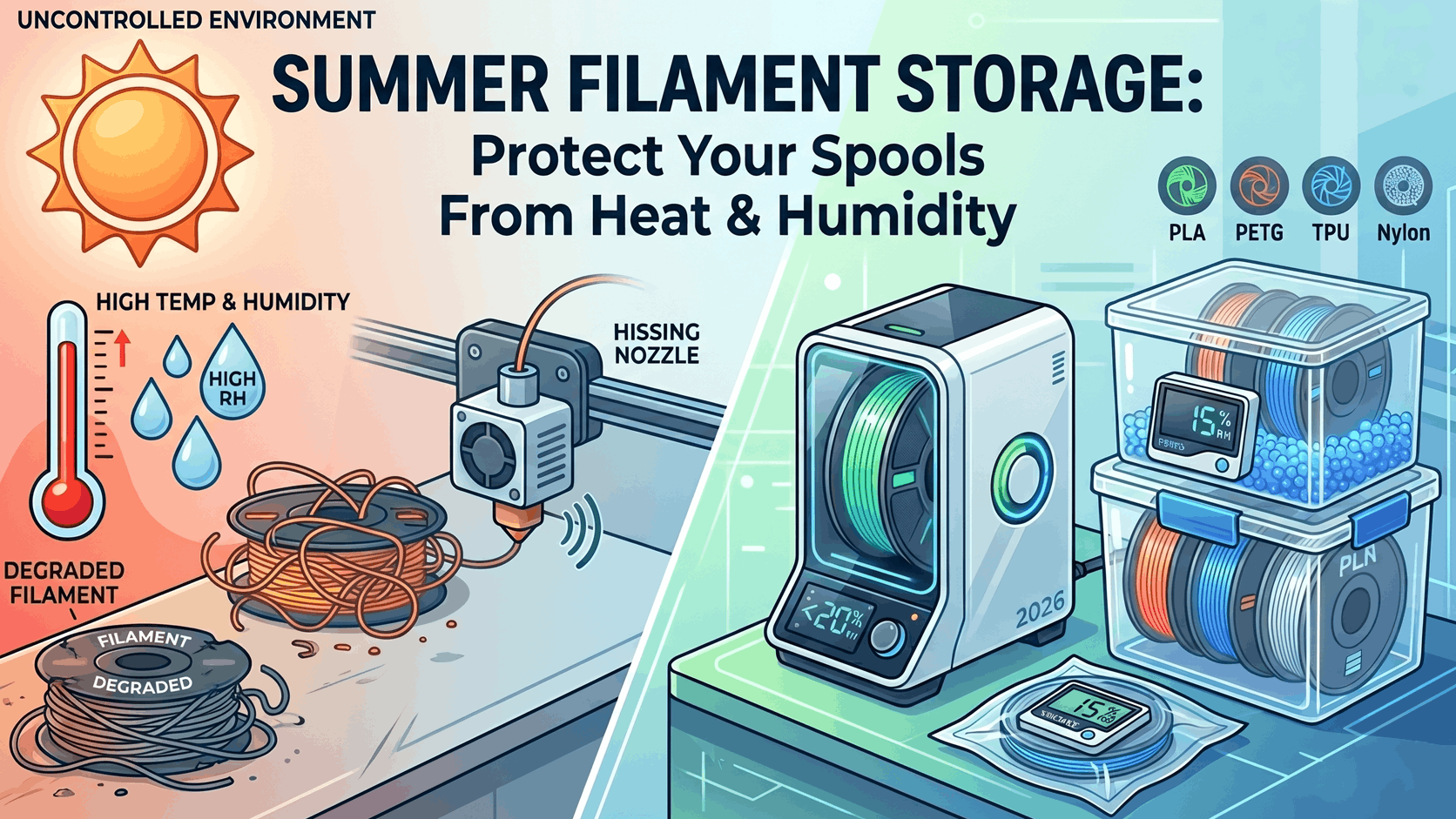
Summer Filament Storage: How to Protect Your Spools From Heat and Humidity in 2026
Summer is the hardest season for your filament shelf. Heat softens spools, humidity ruins prints, and most hobbyists do not realize how fast both happen until they get a hissing nozzle or a deformed roll. Here is a practical summer playbook covering where to store filament, how to dry it, and what to stop doing right now.