PFAS Is Coming for Your Filament Shelf: What the 2026 EU Ban Means for 3D Printing
The EU is finalizing the largest chemical restriction in its history, and it touches 3D printing filament more than most hobbyists realize. Here is what PFAS means for your spools, which materials are most at risk, and what to watch for through 2029.
Josh Holtzclaw
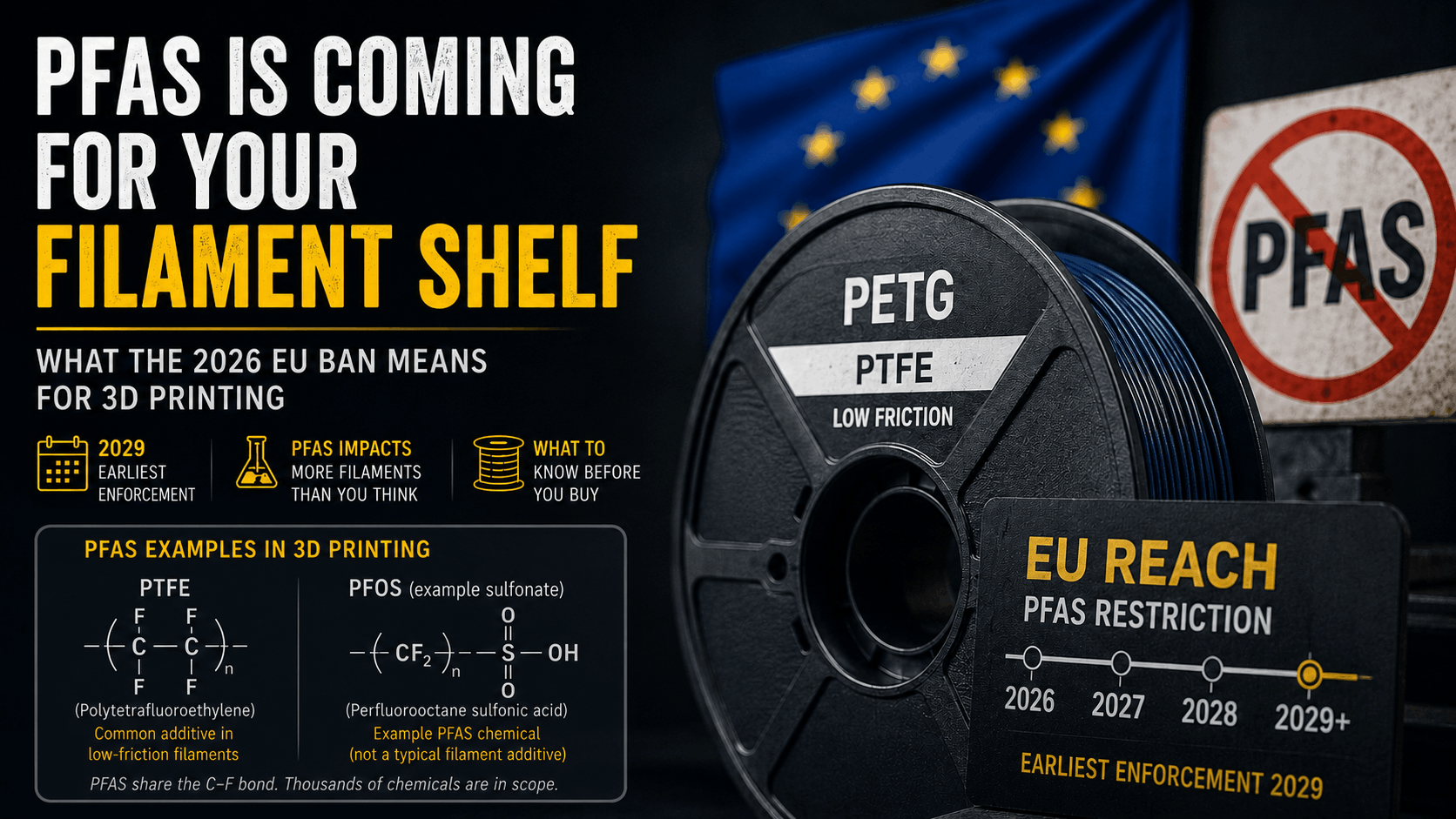
Update (June 2026): the public comment period closed on May 25. ECHA reported 3,511 comments from more than 3,200 organizations and 250 individuals. SEAC is now assessing them and expects to adopt its final opinion by the end of 2026. None of this changes the practical advice below.
In March 2026, the European Chemicals Agency (ECHA) published its committee opinions on the proposed universal restriction of PFAS under EU REACH, the largest chemical restriction in EU history. The public comment period on the Committee for Socio-Economic Analysis (SEAC) draft opinion ran from March 26 to May 25, 2026, drew over 3,500 comments, and the rule could enter force as early as 2029.
3D printing filament does not usually show up in PFAS coverage, but a surprising amount of what sits on your spool rack is in scope. This article walks through what PFAS actually is, which filaments are most likely to reformulate over the next 12 to 24 months, and how to make smart buying decisions before the dust settles.
What PFAS Actually Means in a 3D Printing Context#
PFAS stands for per- and poly-fluoroalkyl substances, a class that ECHA defines structurally as any substance with at least one fully fluorinated CF3 or CF2 carbon atom. That definition covers over 10,000 chemicals, and it includes some materials most filament buyers do not think of as PFAS.
In a 3D printing context, PFAS most commonly show up as:
- PTFE (Teflon) additives blended into filament for self-lubricating, low-friction properties. The classic example is PETG with PTFE, popularized by Fiberlogy as a tough, low-wear material for gears and bearings.
- Fluoropolymer coatings on hot ends, nozzles, and bed-build surfaces (not the filament itself, but a downstream concern for the same regulation).
- Fluorinated dyes and surface treatments used in some specialty colors and finishes.
- PVDF and fluoroelastomer composite filaments used in industrial and chemical-resistant applications.
For most hobbyists printing PLA, basic PETG, ABS, or TPU, the spool itself contains no PFAS. The risk is concentrated in specialty engineering materials and a small number of formulations marketed for low friction.
The Filaments Most Likely to Reformulate#
This is the practical heart of the change. If you buy any of these regularly, expect product updates in late 2026 and 2027.
PETG With PTFE Additives#
The most directly affected mainstream filament is PETG blended with PTFE for low-friction parts. Fiberlogy is the canonical example, and the brand explicitly lists "PETG with PTFE for low-friction parts" as one of its differentiators. Anyone printing gears, bushings, or moving-part assemblies in this material should expect either a reformulation or a clearly labeled non-EU SKU within the next 12 to 24 months.
The good news: PTFE-free alternatives are already shipping. In April 2026, Igus launched Iglidur i190PF, a PTFE-free wear-resistant filament that claims up to 100 times less wear than standard plastics. The company explicitly cites "growing regulatory discussions" as the driver. Expect more brands to follow with their own PTFE-free formulas.
Engineering Composites With Fluorinated Lubricants#
Many high-end engineering filaments use small amounts of fluorinated processing aids or internal lubricants to improve flow at high volumetric rates. These additives are often invisible on a datasheet but fall under the ECHA definition. Expect brands like 3DXTech, BASF Ultrafuse, and Polymaker to quietly tweak formulations in their nylon, polycarbonate, and PEEK-adjacent lines.
If you rely on a specific engineering grade for a production part, ask the manufacturer directly whether they expect PFAS reformulation, and plan for a possible requalification print before adopting a new batch.
Specialty Coatings and Pigments#
A small subset of specialty filaments uses fluorinated pigments, surface treatments, or anti-static additives. Most modern color-effect filaments do not, but the brands that do may need to swap pigment systems. This is a low-impact change for most users but can shift the look of a specific SKU between batches.
Carbon and Glass Composites#
Carbon fiber PLA and carbon fiber PETG composites are usually clean here. Most CF and GF reinforcement uses sized fibers without PFAS coupling agents. A handful of premium composites use fluorinated sizing, but the major hobbyist-grade brands do not.
The Timeline You Actually Need to Know#
The regulation is not a 2026 problem. It is a 2026 to 2029 problem with predictable milestones.
- May 25, 2026 (done): SEAC draft opinion public comment period closed, drawing 3,511 comments now under review.
- End of 2026: SEAC expected to adopt its final opinion and submit it, alongside the RAC opinion, to the European Commission.
- 2027 to 2028: Commission proposes the restriction for discussion and a vote in the REACH Committee of EU Member States.
- 2029 (earliest): Restriction enters force, with most uses subject to an 18-month transition period and some sector-specific derogations.
In other words, nothing on your shelf becomes unusable overnight. The relevant timeline for filament buyers is "watch for reformulations starting in late 2026 and accelerating through 2028."
What This Actually Means for Your Spool Shelf#
For the next six months, nothing changes. Your existing spools work exactly the same.
For the 12 to 24 months after that, expect:
- PETG + PTFE products to either reformulate, get an EU-specific PTFE-free variant, or stop being sold in the EU. US availability of the original formula will likely persist longer but is not guaranteed forever, because global brands generally consolidate formulations rather than maintaining regional SKUs.
- Engineering filament price stability, but with more brands quietly switching internal lubricants. If you have a production-qualified part, lock in a known batch before the next major brand revision.
- More PTFE-free wear-resistant options, and probably some marketing noise about it. Expect "PFAS-free" or "PTFE-free" badges to become a brand differentiator, similar to how "no-Teflon" cookware claims work today.
- Slow consolidation around safer additive packages. This is healthy for the industry, but you may see small print-behavior changes (slightly different flow at high speeds, different friction characteristics on slider parts) when your favorite SKU gets reformulated.
Tip: if you depend on a specific filament formulation for a working assembly, buy enough spools to cover the next 12 months while the original formula is still shipping. Then store them properly. See our filament storage guide so they are still usable when you need them.
How to Future-Proof Your Filament Choices#
A few practical moves keep you ahead of the curve without overreacting.
- Default to single-material formulations for everyday printing. Plain PLA, basic PETG, ASA, and standard ABS are not in scope.
- Check brand pages and datasheets before buying specialty composites or low-friction materials. The filament brand directory is a good starting point, and brand websites are increasingly publishing PFAS statements alongside their MSDS pages.
- Verify additives actually matter for your part. A lot of hobbyists buy PETG+PTFE out of habit when standard PETG would do fine. If you do not need self-lubricating behavior, you do not need to worry about the change.
- Watch for brand reformulation announcements, especially from EU-headquartered brands like Fiberlogy, Polymaker, and Prusament. Reputable brands typically publish a transition note when chemistry changes meaningfully.
- Do not panic-stock industrial materials. The transition period is long, derogations exist for many specialty uses, and reformulated products are often functionally equivalent.
What to Watch Next#
Two threads to keep an eye on through the rest of 2026:
- US response. The EPA has its own PFAS rulemaking under TSCA, and several US states (notably Maine and Minnesota) already have PFAS reporting and restriction rules. Global brands tend to harmonize to the strictest jurisdiction, so US filament buyers will see EU-driven reformulations even without direct US action.
- Industry self-disclosure. Expect brands to start publishing explicit PFAS statements on product pages over the next year. When two brands sell otherwise-comparable PETG, the one with a clear PFAS statement will increasingly win cautious buyers.
The PFAS story is part of a broader 2026 shift in filament chemistry. The same pressure that drove the better-PETG and refill-spool trends is now pushing brands to clean up additive packages too. Combined with the 2026 tariff and price pressure, brands have every incentive to simplify their formulations rather than maintain region-specific SKUs.
The right move for most printers is not to change anything today. It is to know what is changing so you can make informed calls when a favorite SKU disappears or shows up reformulated.
For more context on which brands are taking the lead, see the best 3D printer filament brands ranked, and browse the full filament brand directory for per-brand notes you can use when comparing reformulated options.
Related Articles

Bambu PETG Matte: Specs, Settings, and Who Should Buy It
Bambu Lab's new PETG Matte costs the same as PETG Basic, undercuts PLA Matte, and promises PLA-like printing with supports that peel off by hand. The spec sheet, the settings, and the catches.
Bambu Lab Discontinued PETG HF: What to Use Instead in 2026
Bambu Lab quietly phased out PETG HF in most colors and replaced it with a reformulated PETG Basic. Here is what actually changed, why your old profile will not drop in cleanly, and the best high-speed PETG alternatives to switch to right now.
Why Filament Prices Just Surged in 2026: Tariffs, Shortages, and How to Keep Printing Affordably
Filament prices jumped as much as 59% in 2026. Here is what is driving it (tariffs, supply crunches, TPU shortages) and the practical moves that keep your cost-per-print low.