Summer Filament Storage: How to Protect Your Spools From Heat and Humidity in 2026
Summer is the hardest season for your filament shelf. Heat softens spools, humidity ruins prints, and most hobbyists do not realize how fast both happen until they get a hissing nozzle or a deformed roll. Here is a practical summer playbook covering where to store filament, how to dry it, and what to stop doing right now.
Josh Holtzclaw
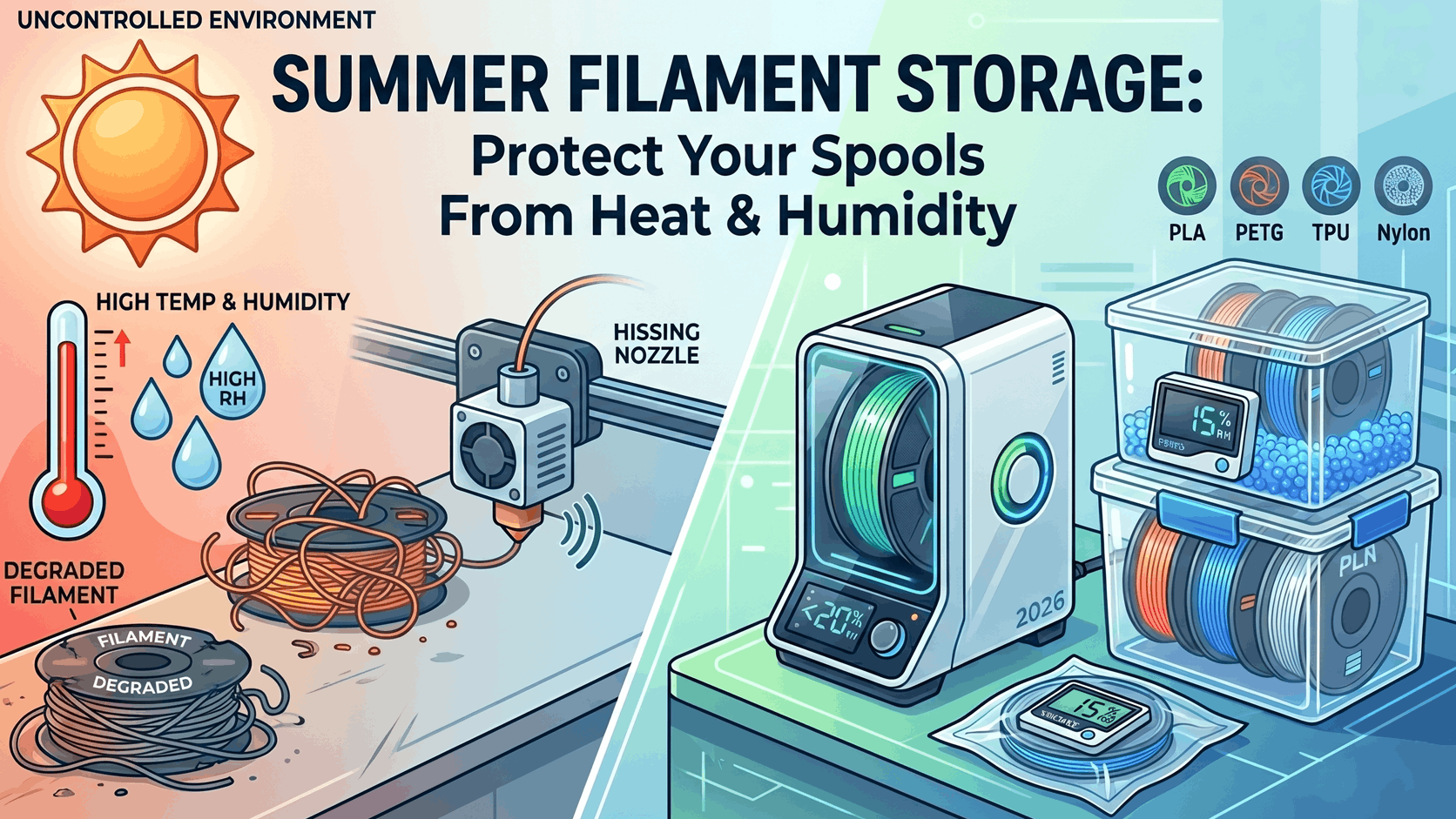
Summer is the riskiest season for your filament shelf. Indoor humidity rises along with outdoor humidity, and a garage that prints fine in November can hit temperatures that physically deform a PLA spool in July. Both problems compound. A roll that absorbs moisture all summer and then gets used in autumn produces hissing extrusion, brittle parts, and zero idea why your prints suddenly turned bad.
This guide is a practical summer playbook. It covers what heat actually does to your spools (not just your prints), why summer humidity hits faster than winter humidity, where to store filament, and the active drying setup that pays for itself in one ruined nylon spool.
Why Summer Hits Filament Twice#
Most storage advice focuses on humidity. That is the bigger long-term threat, but in summer you are fighting two problems at the same time.
Humidity Goes Up Right When You Want To Print More#
Indoor relative humidity in most US homes runs about 30-50 percent in winter (heated air is dry) and 60-80 percent in summer, especially in the Southeast, Gulf Coast, and any coastal climate. PLA that prints fine off the open shelf in February will degrade noticeably within one to two weeks in July. PETG, TPU, and any nylon absorb moisture two to four times faster in the same conditions.
The painful version of this is the spool you opened in May, used twice, and left on the shelf until late August. It is not "kind of damp." It is fully saturated and probably needs 6-12 hours in a dryer before it will print cleanly again.
Heat Threatens The Spool Itself, Not Just The Print#
This is the part most storage guides skip. Garages, sheds, and attics in summer can easily exceed 40-50°C. PLA has a glass transition temperature around 55-60°C, which means a 50°C garage puts your spools uncomfortably close to softening.
Three things go wrong when filament spends time at those temperatures:
- The spool deforms under its own weight. The bottom of the roll compresses, the windings stick together, and the filament develops kinks that catch in extruders.
- Layer stress relaxes. Filament is wound under tension during manufacturing. Heat lets that tension out, and the roll uncoils unevenly or springs apart when you open the bag.
- Heat creep takes over your printer. Hot ambient air around the extruder makes the filament soften too early in the heat break, causing clogs and under-extrusion. The same printer that ran flawlessly all spring starts failing prints in July without any settings change.
Tip: if your printer suddenly clogs in summer after months of clean operation, check the ambient temperature near the extruder before you tear apart the hot end. A 35°C room can push the heat break above the filament's softening point.
The Humidity Problem And Why Summer Is Different#
In dry climates (below 40 percent average humidity year-round), an open spool can sit on a shelf for weeks and still print fine. In humid climates, the same spool is unusable in days.
Approximate moisture-absorption tolerance from open-shelf storage in 60-plus percent humidity:
- PLA: noticeable degradation in 1-2 weeks
- PETG: hissing and stringing in 7-10 days
- TPU: surface roughness within 3-5 days
- Nylon: fully saturated in 18-24 hours
You can hear wet filament before you see it. Listen at the nozzle. A faint hiss or pop is steam from moisture flash-boiling at extrusion temperature. The visible symptoms are stringing, surface zits, weak layer adhesion, and matte patches on what should be glossy material.
A spool that looks fine but sounds wet is not salvageable by printer settings. It needs heat to drive the water out. See the filament drying and storage guide for the full drying-temperature reference, but the summer short version is: PLA at 45-50°C for 4-6 hours, PETG at 65°C for 4-6 hours, TPU at 50-55°C for 6-12 hours, and nylon at 70-80°C for 8-12 hours.
Where Not To Store Filament In Summer#
A short list of places that will quietly ruin your spools through June, July, and August:
- Garages and sheds. Both temperature and humidity are uncontrolled, and most have poor insulation. A west-facing garage can hit 45°C inside on a normal August afternoon.
- Attics. Worse than garages. Heat rises, ventilation is minimal, and any spool stored above an insulated ceiling is functionally inside an oven.
- Open shelves in any non-air-conditioned space. The filament is in equilibrium with the room. If the room is humid, the spool is humid.
- Sunny windowsills. Direct sunlight adds UV degradation to PLA and accelerates color shift in dyed filaments. Prolonged direct sun affects any filament over time. ABS has poor UV resistance and yellows and embrittles outdoors, while ASA is formulated for UV resistance and holds up far better, though it is not immune to long exposure.
- Sealed cardboard boxes in damp basements. Cardboard is not a moisture barrier. If your basement smells musty, your spools are absorbing what is in the air.
Where To Store Filament In Summer#
The ideal storage environment in summer is the same as the ideal in winter: cool, dry, dark, and sealed. The difference is that summer is unforgiving about each one.
- A climate-controlled interior room. An air-conditioned office, finished basement, or interior closet hits all four. Keep filament away from exterior walls if you live in a humid climate, because exterior wall surfaces can be cooler and condense moisture during AC cycles.
- Sealed dry boxes with active humidity monitoring. A clear bin, a tight gasket, a tray of fresh silica gel, and a $5 hygrometer. Target below 20 percent relative humidity for any storage. Below 15 percent is better for TPU and nylon. Replace or regenerate the silica when the indicator card turns pink.
- Vacuum-sealed bags for long-term storage. Spools you do not expect to use for 30-plus days should be vacuum bagged with a small desiccant packet. Standard food vacuum sealers work fine. This is the cheapest way to keep a backup roll of carbon fiber PLA or nylon ready to print.
- A filament dryer used as active storage. Dedicated filament dryers (Sunlu S2/S4, Eibos, PrintDry, Bambu AMS HT) double as humidity-controlled storage between prints. For nylon, TPU, and any composite filament, this is the only reliable option in humid climates.
Tip: silica gel keeps dry filament dry. It does not dry already-wet filament. If your spool is hissing, run it through a heated dryer first, then store it with fresh desiccant. Skipping the heat step just stores wet filament in a sealed box.
The Print-Through-Dryer Trick#
For materials that absorb moisture in hours rather than days, even great storage is not enough. The filament absorbs moisture during the print itself, between the spool and the extruder.
The fix is a print-through-dryer setup: a heated dryer that holds the spool and feeds directly to the printer through a short, sealed PTFE tube. The filament never touches ambient air. This is standard practice for anyone printing nylon, TPU 95A, PA6, PA12, or carbon-fiber composites in any humid climate.
If you only need it occasionally, a Sunlu S4 or Eibos PolyDryer paired with a PTFE feed line costs $80-150 and pays for itself the first time it saves a multi-day nylon print.
Buying Filament During Summer#
Two things to watch when ordering in hot months:
- Shipping conditions. Spools spend days in trucks that hit 60°C+ interior temperatures. Major brands ship in foil-sealed moisture-barrier bags with desiccant, so the moisture half is usually fine, but heat can soften the spool windings during transit. Check the spool for ovalization or sticky windings when it arrives. Most reputable brands will replace heat-damaged inventory.
- Brand reputation matters more in summer. Brands that skimp on packaging quality (thin spools, no desiccant, weak bag seal) get exposed in summer shipping. The best-brand rankings reflect packaging quality alongside print performance. Prefer brands that ship in vacuum-sealed bags with intact desiccant during the summer months.
This connects to the 2026 filament price pressure story too. With prices up, the cost of a spool ruined by bad summer shipping or bad storage stings more than it used to. The storage system is part of the cost-per-print calculation now.
What To Stop Doing Right Now#
If you take three things from this guide:
- Get spools out of the garage. Move them to a climate-controlled interior space today. The longer they sit at 40°C, the more damage compounds.
- Seal anything you are not actively using. Dry box, vacuum bag, sealed bin with desiccant. Pick one. Open shelves are a luxury you cannot afford in July.
- Verify humidity with a real hygrometer. A $5 digital reader inside your dry box is the only way to know if your storage is working. If you do not measure, you are guessing.
Summer storage discipline is what separates printers who lose half a spool a month to humidity from printers who get the full kilogram off every roll. Get it right now and your prints in September will look the same as your prints in April.
For the deeper material-by-material drying table and storage breakdowns, see the full filament drying and storage guide. For brand-specific notes on packaging quality and consistency, the filament brand directory and the brands ranking are good starting points.
Related Articles
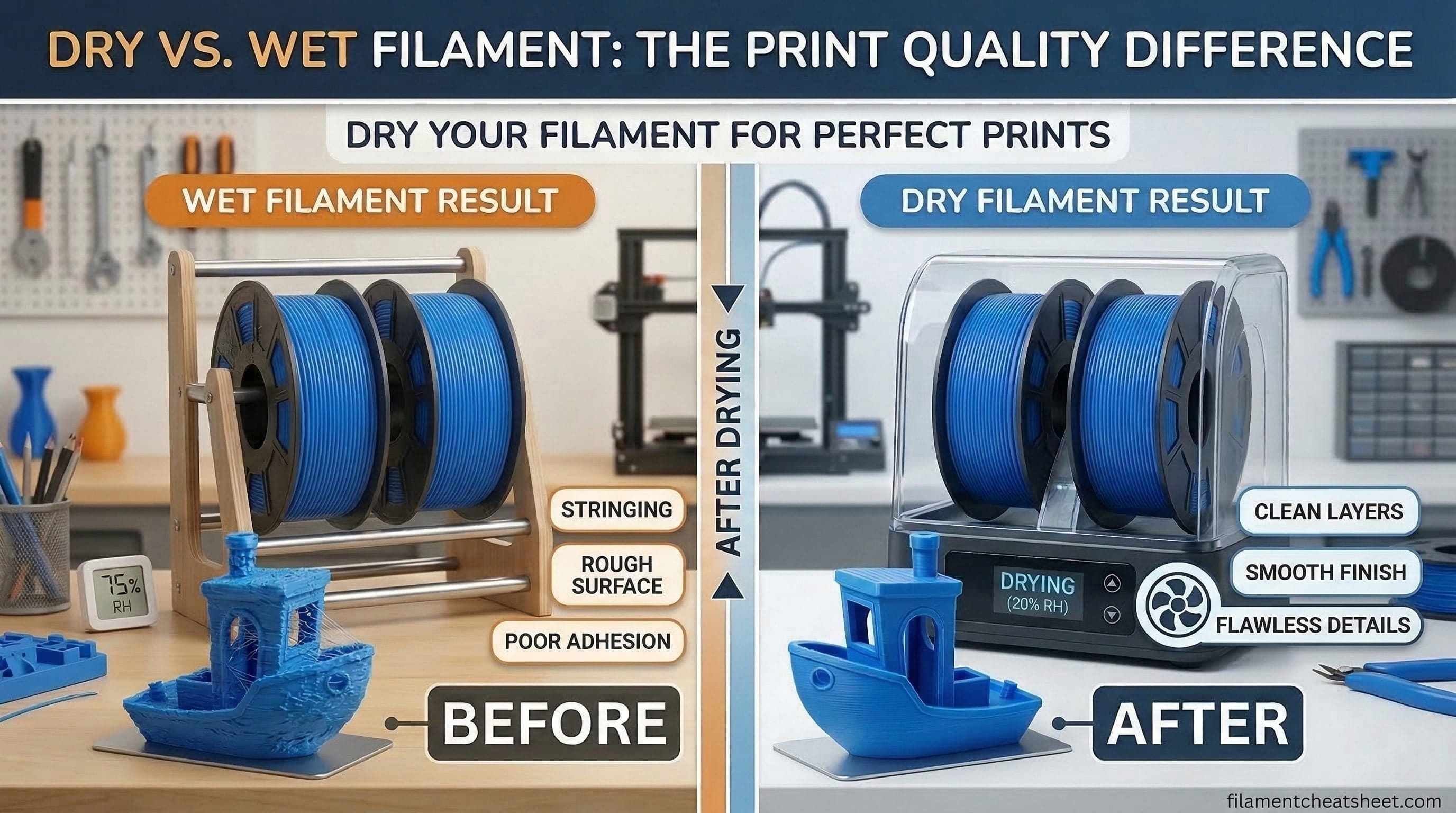
How to Dry and Store 3D Printing Filament (So It Stops Ruining Your Prints)
A practical guide to filament moisture, how to spot it, how to fix it, and how to keep every spool dry long-term with the right storage and drying setup.
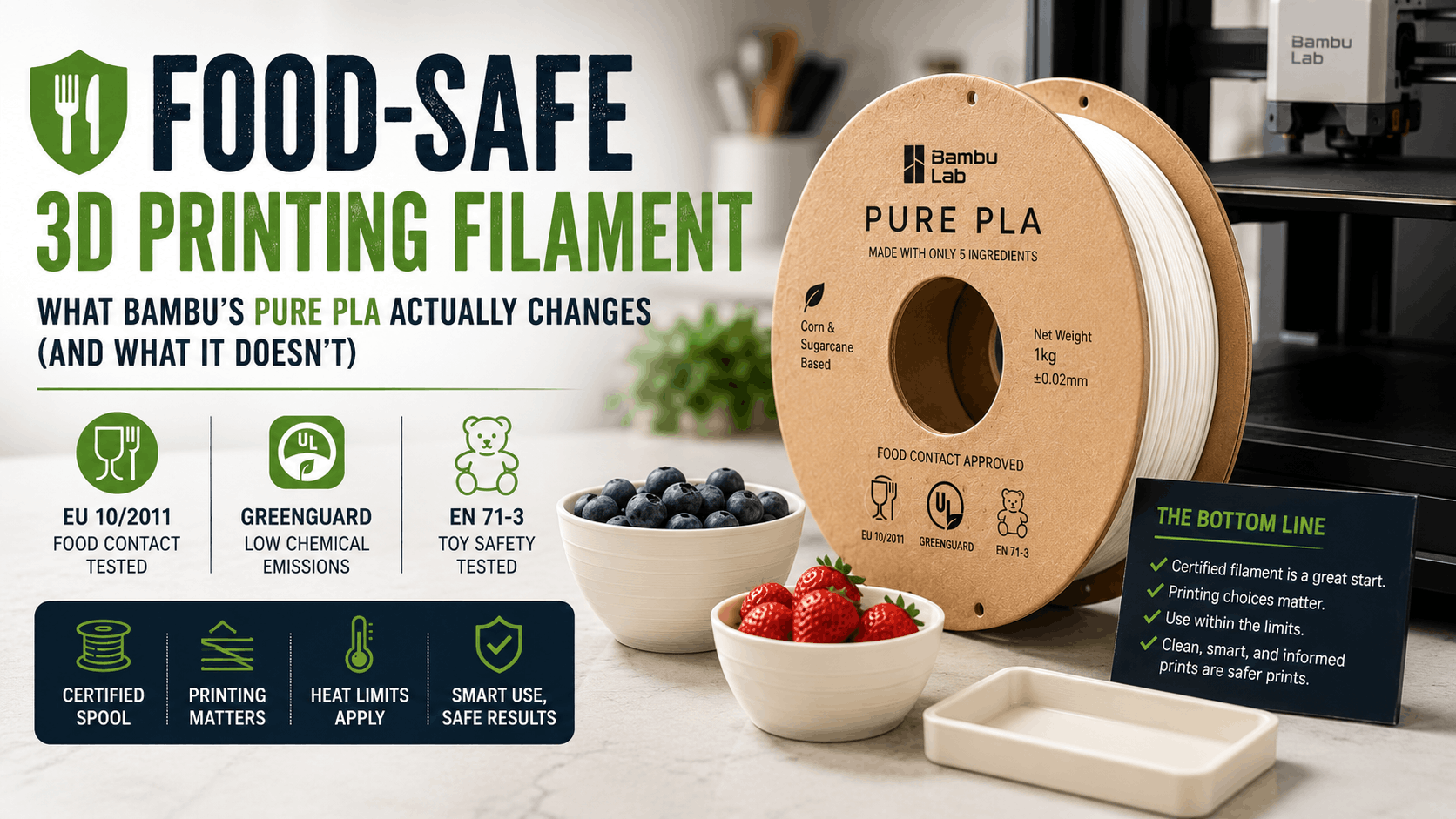
Is Bambu PLA Pure Food Safe? What the Certification Covers
Bambu PLA Pure is certified under EU 10/2011 for food contact, but that certifies the filament, not your printed part. What the certification covers, and where the real risk is.

High-Speed Filaments Are Getting Serious: PETG HF (and Friends) in 2026
High-speed filaments are no longer just PLA at 200 mm/s. PETG HF and other high-flow blends are changing what fast, reliable printing looks like.