Bambu Lab Discontinued PETG HF: What to Use Instead in 2026
Bambu Lab quietly phased out PETG HF in most colors and replaced it with a reformulated PETG Basic. Here is what actually changed, why your old profile will not drop in cleanly, and the best high-speed PETG alternatives to switch to right now.
Josh Holtzclaw
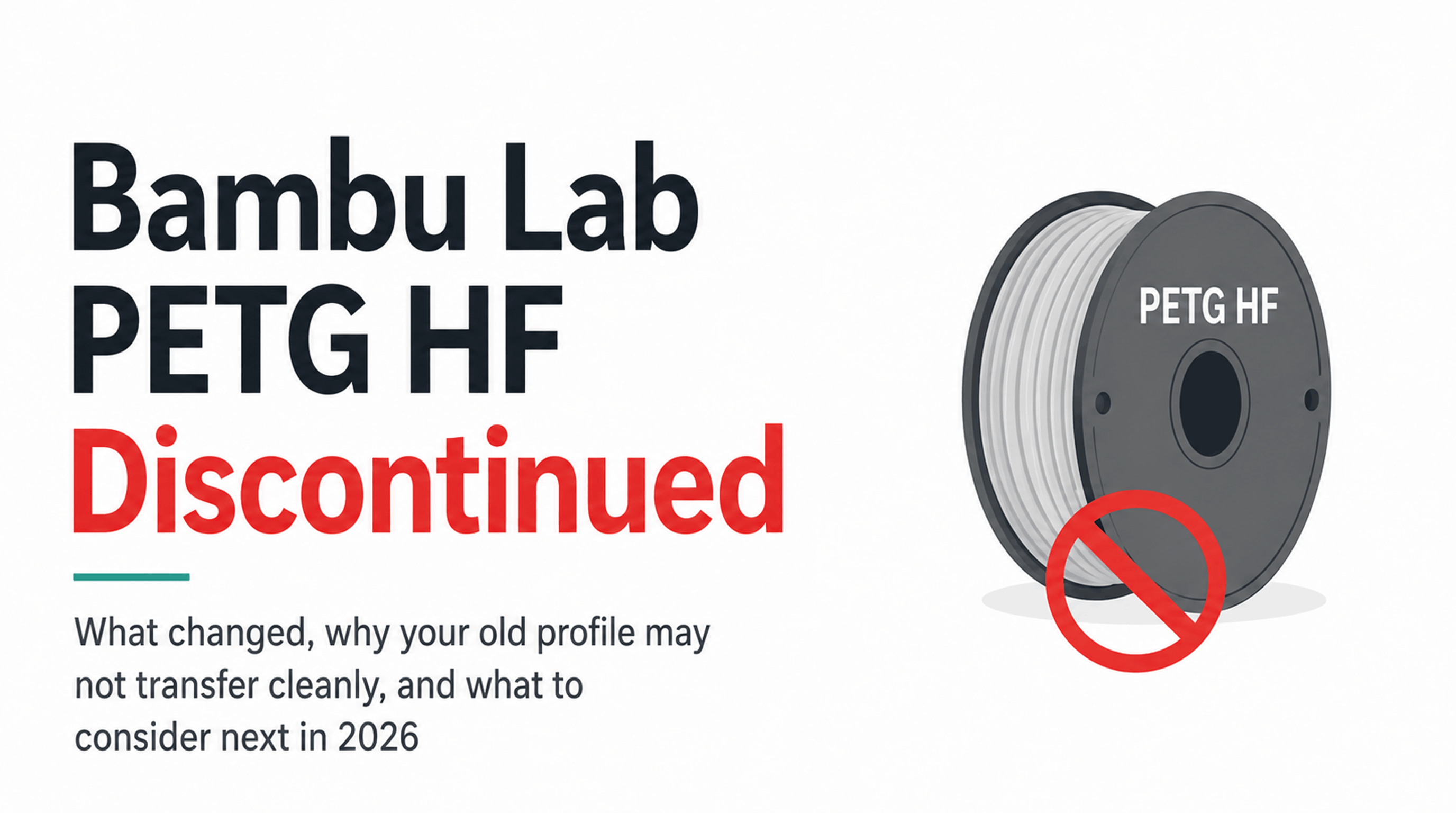
If your favorite color of Bambu PETG HF stopped reappearing in stock, it is not a temporary shortage. Bambu Lab has quietly discontinued PETG HF across most colors, keeping only black in the lineup, and repositioned a reformulated PETG Basic as the successor. The change was announced formally to Japanese customers earlier this year, but most North American and European buyers found out by watching colors vanish from inventory without explanation.
We covered the rise of high-speed PETG HF and similar high-flow filaments back in February, when PETG HF was the material everyone wanted and nobody could keep in stock. The irony is that the supply problem never really got fixed. Bambu pulled the product instead. Here is what changed, why your old profile will not drop straight in, and what to switch to.
What Actually Happened#
Bambu Lab is phasing out the PETG HF refill SKUs in every color except black. Filament-with-spool versions are also disappearing as stock clears. The replacement is a revised PETG Basic that returned in early 2026 with a reformulated compound.
The official framing is that PETG Basic addresses the two biggest complaints about PETG in general: moisture sensitivity and stringing at high speed. On paper, the revised PETG Basic is actually the stronger material:
- Higher flexural strength in the XY plane (around 75 MPa vs 64 MPa for PETG HF)
- Better layer adhesion in the Z direction (around 56 MPa vs 48 MPa)
- Higher impact strength (about 34 kJ/m² vs 31.5 kJ/m²)
So the replacement is tougher and more durable. The catch is speed.
Why It Is Not a Drop-In Replacement#
PETG HF existed for one reason: it flowed cleanly at very high volumetric rates so Bambu's fast printers could run PETG above 300 mm/s without turning into stringing machines. The revised PETG Basic tests stronger, but community reports are consistent that it does not fully match HF behavior at maximum speeds, especially above 350 mm/s on X1C or P2S hardware.
If you run aggressive speed profiles, plan for a re-tuning session rather than a one-click profile swap. The most sensitive variable is temperature:
- PETG Basic 2026 tends to run cleanly around 240 to 245°C
- PETG HF often needed 245 to 250°C on the same profile
- Lowering temperature slightly while keeping speed the same is the most common successful adjustment
A practical dial-in sequence: run a temperature tower first, then a retraction test, then a speed test at your target rate. Most users land between 240 and 243°C with minimal other changes. If you push past 350 mm/s consistently, budget a few test prints.
Tip: whatever PETG you switch to, dry it before the first print. PETG is moisture-sensitive enough that a wet spool will undo any profile tuning you do. See our filament drying and storage guide before you blame your settings.
Should You Stock Up on PETG HF?#
If you have standardized parts on a specific PETG HF color, especially the popular grays, the answer is probably yes for the short term. Bambu is not recalling existing inventory, but once it sells through it will not be replenished. Third-party retailers in North America (Amazon, MatterHackers, Printed Solid) and several EU distributors may still have HF stock in select colors for a few more weeks.
Buy what you need to finish color-matched projects, then migrate to a long-term alternative while you still have time to tune it. Do not over-stock, though. PETG HF is moisture-sensitive, and a year-old spool stored badly is worth less than a fresh roll of a comparable alternative.
The Best PETG Alternatives to Switch To#
The good news is that the high-speed PETG field got crowded while Bambu was struggling to keep HF in stock. Several alternatives now match or beat it.
Bambu PETG Basic 2026 (the official path)#
For most Bambu users who print at standard-to-fast speeds, the revised PETG Basic is the path of least resistance. RFID auto-loads the profile, it feeds the AMS cleanly, refills keep cost down, and it tests stronger than HF. Just do not expect it to match HF above 350 mm/s without tuning.
Polymaker PETG (new high-speed formula)#
Polymaker retired PolyLite PETG and replaced it with a new high-speed formula simply called Polymaker PETG, engineered for up to 300 mm/s with notably better layer adhesion than PolyLite. It is the strongest direct competitor to Bambu's high-speed PETG and is rapidly becoming the community default for anyone who wants color variety or prints across multiple machines. If you bought PolyLite PETG in the past, check stock carefully, the transition is in progress.
Elegoo Rapid PETG#
Elegoo Rapid PETG has a strong reputation as a near drop-in for Bambu's high-speed settings. Community testers report it performs essentially the same as PETG HF after a small tuning pass, often at a lower price. It works with either the Bambu or Generic PETG HF profiles as a starting point.
SUNLU High Speed PETG#
SUNLU High Speed PETG has become a popular budget pick, frequently beating Elegoo on price per kilo. It needs a profile tweak but holds up well for functional parts, and the matte grays are a close match for the Bambu colors people are trying to replace.
Overture and Siraya Tech#
Overture PETG is widely available and fine for moderate speeds, though some users report more batch variance. Siraya Tech ships a dedicated PETG HF line specifically marketed for high-speed printing if you want a true high-flow formulation rather than a standard PETG pushed fast.
What This Means for the Bigger Picture#
This is part of a pattern. Bambu has been pulling filament manufacturing in-house and letting existing third-party-made stock dwindle while it ramps its own production. PETG HF was a casualty of that transition as much as a product decision. The lesson for buyers is that single-source dependence on any one brand's exact SKU is risky, especially in the current market.
It also reinforces a theme we keep coming back to: for everyday functional printing under about 250 mm/s, standard PETG from any quality brand is fully adequate. The high-flow premium only matters if you genuinely print fast. If you were buying PETG HF out of habit rather than need, this is a good moment to simplify.
Bottom Line#
- PETG HF is gone in all colors except black. Do not wait for a restock that is not coming.
- If you print at normal speeds, switch to Bambu PETG Basic 2026 and run a temperature tower. Most land at 240 to 243°C.
- If you push past 350 mm/s, look at Polymaker PETG, Elegoo Rapid PETG, or a dedicated Siraya Tech PETG HF line, and budget a tuning session.
- Stock a little of your exact HF color now if you have color-matched projects, but do not hoard.
For help choosing a replacement brand, see the best 3D printer filament brands ranked and the full filament brand directory. If you are weighing PETG against other materials for a project, our PLA vs PETG comparison and the filaments index are good next stops.
Related Articles
Bambu PETG Matte: Specs, Settings, and Who Should Buy It
Bambu Lab's new PETG Matte costs the same as PETG Basic, undercuts PLA Matte, and promises PLA-like printing with supports that peel off by hand. The spec sheet, the settings, and the catches.
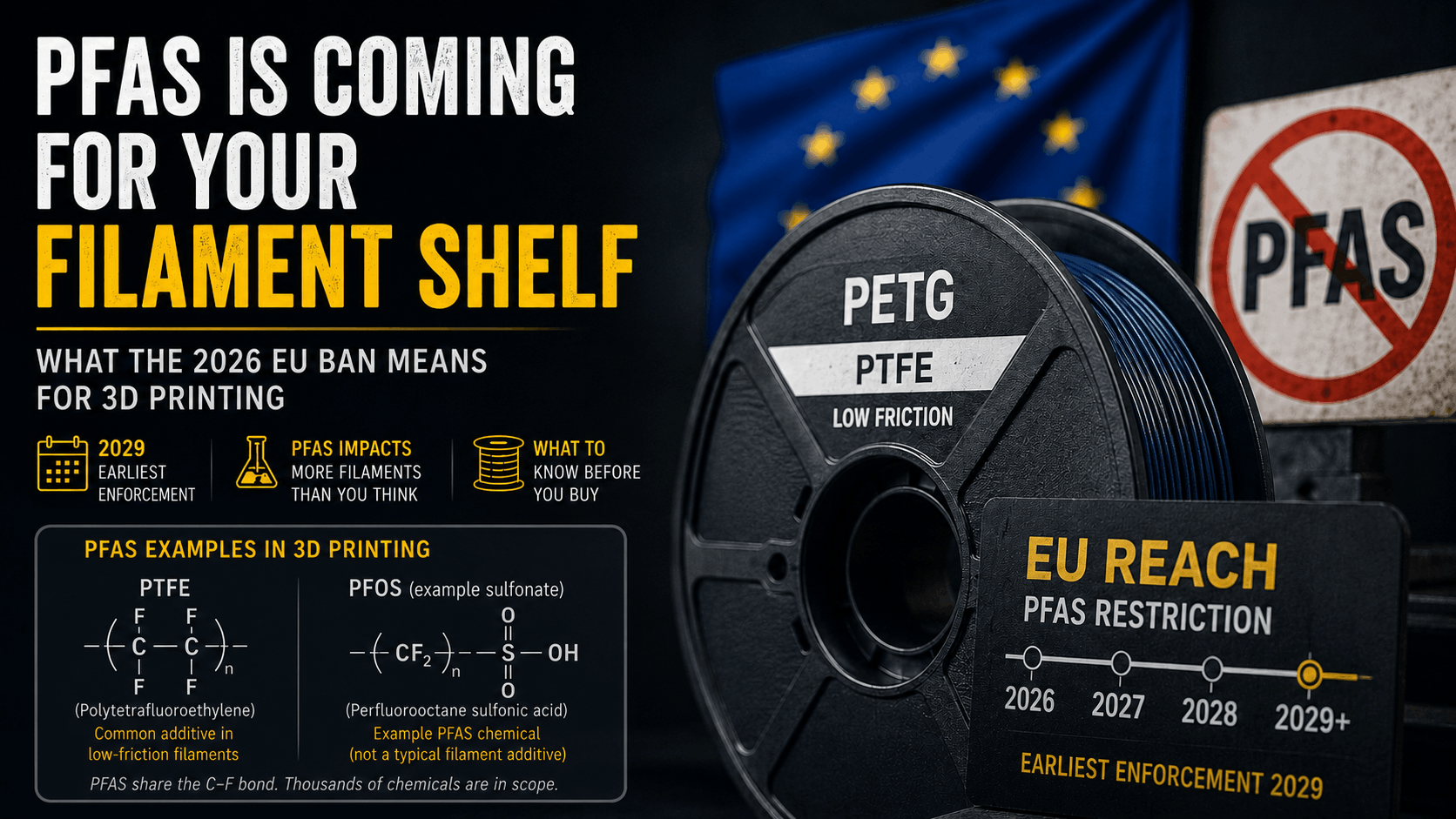
PFAS Is Coming for Your Filament Shelf: What the 2026 EU Ban Means for 3D Printing
The EU is finalizing the largest chemical restriction in its history, and it touches 3D printing filament more than most hobbyists realize. Here is what PFAS means for your spools, which materials are most at risk, and what to watch for through 2029.
Why Filament Prices Just Surged in 2026: Tariffs, Shortages, and How to Keep Printing Affordably
Filament prices jumped as much as 59% in 2026. Here is what is driving it (tariffs, supply crunches, TPU shortages) and the practical moves that keep your cost-per-print low.