PLA vs PETG vs TPU: Which Filament for Which Job (2026)
PLA for easy rigid prints, PETG when it needs to be tough, TPU when it has to bend. Print temps, Shore hardness and a side-by-side table for all three.
Josh Holtzclaw
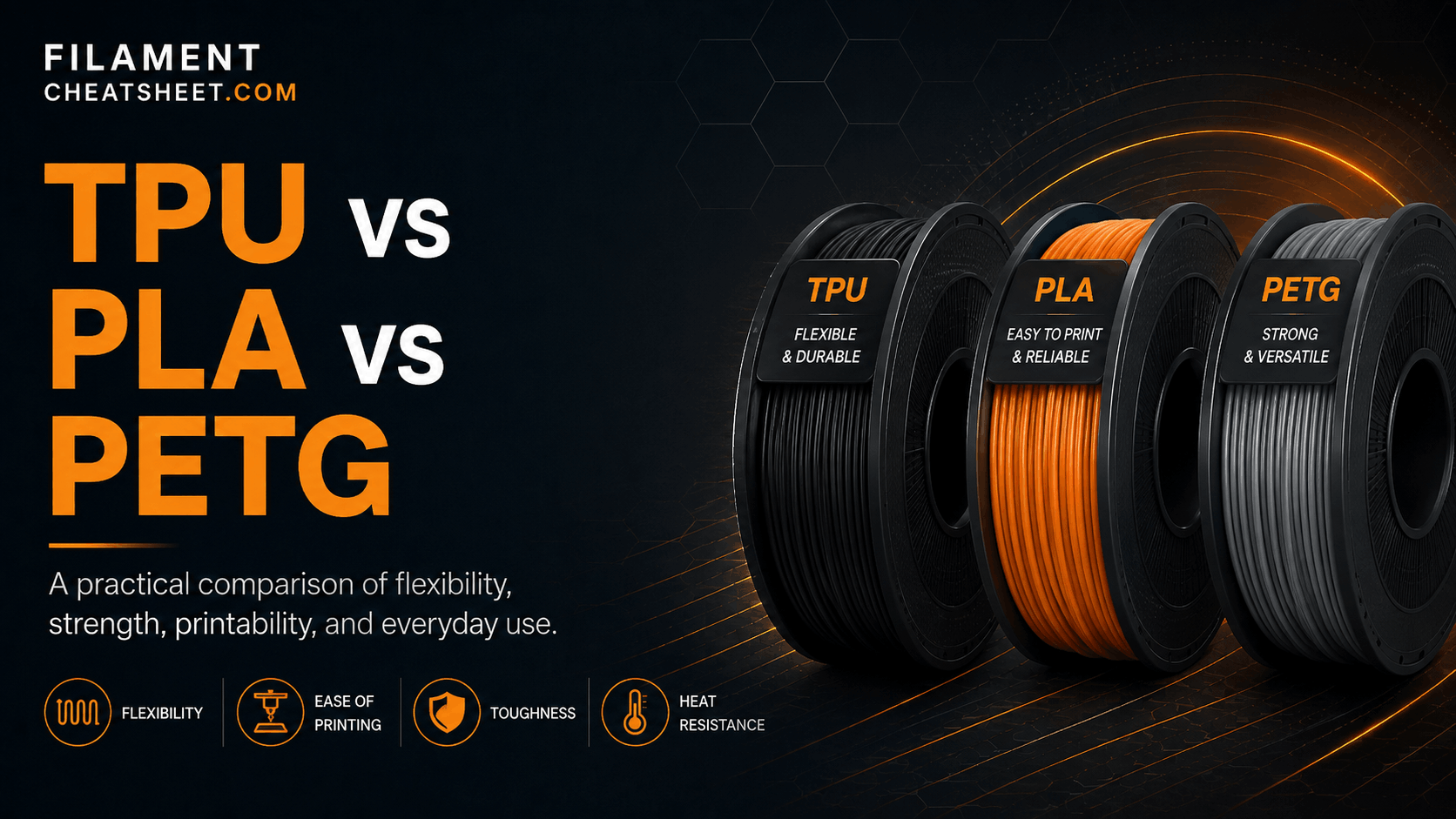
Use TPU when the part must bend, squeeze, grip, or absorb impact. Use PLA for easy indoor models and prototypes that stay rigid. Use PETG for functional rigid parts that need more toughness and heat resistance than PLA. PETG has a little give, but it is not a flexible filament. If you want rubber-like behavior, start with TPU 95A.
That three-way split is the whole decision. The rest of this guide is the data behind it: temps from our filament cheat sheet, mechanical numbers from published datasheets, and the hardware traps that make TPU feel "impossible" on the wrong printer. Pair-by-pair property grids live on PLA vs TPU and PETG vs TPU. For brands after you pick a material, see the TPU, PLA, and PETG rankings.
TPU vs PLA vs PETG at a Glance#
| Property | PLA | PETG | TPU (95A) |
|---|---|---|---|
| Flexibility | Rigid, brittle on impact | Rigid with a little ductility | Rubber-like; stretches several times its length |
| Shore hardness | ~81 Shore D (Prusament PLA) | ~74-79 Shore D (Prusa PETG grades) | ~95 Shore A (Polymaker PolyFlex TPU95) |
| Stretch before failure | ~3% at yield (printed) | ~3.5-4.5% at yield (printed) | ~330-560% at break (printed) |
| Heat resistance | Low (~55°C HDT) | Moderate (~68°C) | Misleading on paper; squishes under heat plus load |
| Nozzle temp | 190-220°C | 230-250°C | 200-240°C |
| Bed temp | 50-60°C | 70-90°C | 30-60°C |
| Enclosure | Not needed | Optional | Not needed |
| Ease of printing | Easiest | Easy, with more stringing | Hardest of the three; slow, prefers direct drive |
| Moisture | Moderate | Moderate; wet PETG strings | High on most spools; dry before printing |
| Typical speed | Fast on modern machines | Fast with HF blends | Slow (often 20-50 mm/s) |
| Best for | Models, prototypes, indoor display | Brackets, enclosures, durable rigid parts | Gaskets, grips, bumpers, wheels, crash parts |
Temps and enclosure notes match our PLA, PETG, and TPU material pages. The stretch row is not one clean apples-to-apples number: rigid plastics are quoted at the yield point (where they stop springing back), elastomers at break. That gap is the story, but do not read "3% vs 500%" as a single test. All of these are lab values from one manufacturer's printed specimens, not a promise for every Amazon spool. Use them to compare classes, then tune the roll in front of you.
The 30-Second Decision#
Ask one question: does this part have to stay rubbery after it leaves the printer?
- Yes (it must flex, rebound, seal, or soak impact): TPU.
- No, and it is a model, prototype, or indoor display piece: PLA.
- No, and it is a functional rigid part (bracket, case, clip, tool): PETG.
If the part will live in a hot car, in sun, or near a heat source, none of these three is the first pick. Step up to ASA or another high-temp material. PLA will sag; PETG is only a short-term outdoor compromise; TPU can feel fine at room temp and still creep when it is hot and loaded. See the filament tier list when the job leaves this trio.
What "Flexible Filament" Actually Means#
People search "is PETG flexible" because PETG bends a little before it snaps, and PLA often does not. That is ductility, not elasticity.
- PLA is stiff. Thin walls can flex a tiny bit, then they crease or shatter.
- PETG yields instead of shattering. A thin PETG clip can spring a little, then it takes a set.
- TPU stretches and (mostly) comes back. That is the only common desktop filament in this trio that behaves like rubber.
Hardness is reported on two scales, and mixing them is how 95A TPU gets sold as "super soft." Shore A is for elastomers. Shore D is for rigid plastics. TPU 95A is the firm end of flexible filament, about as hard as a skateboard wheel or shopping-cart tire. Thick TPU walls feel almost rigid. Thin TPU walls (1-2 perimeters, low infill) are what feel squishy.
If you wanted a rubber band, you wanted soft TPU around 80-85A, not a 95A roll. Soft TPU is much harder to feed. Start at 95A unless the part is a gasket or wearable that has to collapse in your hand.
Strength vs Toughness (Is TPU Stronger?)#
"Is TPU stronger than PLA?" is the wrong question. PLA usually wins a straight tensile pull. TPU wins anything that hits, drops, or bends.
Prusament PLA printed on the XY plane shows about 51 MPa tensile yield, 2.9% elongation at yield, and 13 kJ/m² Charpy impact. Prusa's PETG family sits lower on tensile (roughly 40 MPa) and about twice that impact energy (23-25 kJ/m² on their PETG Recycled / PETG V0 sheets). Polymaker PolyFlex TPU95 lists ~29 MPa tensile (ASTM D638) with 330% elongation, or 551% on the elastomer (ISO 37) method.
Two caveats so those numbers do not mislead you:
- Do not compare elastomer tensile MPa to PLA tensile MPa as if they were the same test. ISO 37 (rubber) and ISO 527 (rigid plastic) are different protocols. Elongation and impact are the honest "which survives abuse" metrics.
- TPU's superpower is energy absorption. An FPV drone bumper, phone case, or combat-robot armor wants TPU because it deforms and returns. A shelf bracket wants PETG because it must hold shape under load.
Layer adhesion is excellent on TPU, which is why flexible parts often fail in the bulk rather than splitting on layer lines. PLA is the opposite: it looks strong until a drop finds a layer.
For the two-material versions of this argument, use PLA vs TPU and PETG vs TPU. PLA vs PETG (no flex) is covered in PLA vs PETG: which should you use and the PLA vs PETG compare page.
Heat: The Number That Lies on TPU#
PLA is the clear loser in heat. Prusament PLA's heat deflection temperature is 55°C at both 0.45 MPa and 1.80 MPa. A dashboard, a sunny window, or a closed car in summer will deform it. That is why PLA is a display and prototype material, not a functional outdoor one.
PETG is the practical step up. Prusa rates Prusament PETG temperature resistance at 68°C. It is still not ASA, but it survives indoor functional use that kills PLA.
TPU datasheets can look hotter. Prusament TPU 95A lists HDT of 78.6°C at 1.80 MPa. Read the compression-set row on the same sheet: at 70°C the printed specimen keeps about 70% of the imposed squash. HDT says "it has not melted." Compression set says "it will not spring back if you leave it hot and squeezed." Do not use TPU for a loaded part that sits warm.
Ease of Printing, Speed, and Hardware#
PLA is the reason consumer FDM took off: no enclosure, wide temp window, high cooling, and it runs fast on CoreXY machines. If you are new, print PLA first. Our getting started with PLA guide is the on-ramp.
PETG is the next spool most people should buy. It wants a hotter nozzle (230-250°C), a hotter bed (70-90°C), and moderate cooling. Too much fan weakens layer bonds. Stringing is the usual complaint; dry the spool before you chase retraction. See how to dry and store filament and the stringing troubleshooting guide.
TPU is a different sport:
- Slow. Polymaker's TPU95 profile is 30-50 mm/s (older sheets said 20-40). High-flow TPU exists (Bambu TPU 95A HF), but "print it like PLA" is still how you get jams.
- Direct drive strongly preferred. Our printer requirements for TPU mark direct drive as strongly recommended. The filament is squashy. A long Bowden tube lets it buckle, then the extruder chews a mess. 95A can print on a well-constrained Bowden path at low speed with tiny retraction. 85A generally cannot. See clogging if the drive gear has already eaten a spiral of TPU.
- Retraction is the enemy. Start near zero and add only enough to cut stringing. Long retractions on TPU are a jam recipe, especially in Bowden.
- AMS is still a TPU problem. Bambu's filament guide lists standard TPU 95A / 90A / 85A as too soft for AMS and AMS lite. As of 2026, TPU for AMS is the product that actually feeds through AMS units. Regular 95A belongs on an external spool holder, or through the dedicated TPU outlet on AMS HT (as a dry box, not as a normal feeder). Details: Bambu TPU printing guide and our Bambu Lab compatibility page.
Enclosure is not the blocker. PLA and TPU do not need one. PETG is optional. If TPU is failing, look at feed path, speed, and moisture, not chamber temp.
Moisture: Dry TPU First#
Our material data rates TPU moisture sensitivity as high. Wet TPU strings, bubbles, and looks like you need a new printer. You usually need a dryer.
Commodity ester-based TPU is thirsty. Ether-based TPU is the exception: Prusament TPU 95A measures 0.02% moisture in 24 hours versus 0.13% for their PLA. That is a chemistry difference, not a reason to skip drying a Hatchbox or eSUN roll that sat open.
Dry TPU around 70°C for 8 hours (Polymaker's TPU95 setting; Bambu's table is in the same neighborhood). Then print from a dry box if your room is humid. PETG and PLA are moderate: dry them when they start stringing or after weeks in open air, not as a religion. Nylon is worse than all three; do not treat TPU like nylon, but do not treat it like PLA either.
When to Use TPU#
Print TPU when the part's job is to deform without breaking:
- Gaskets, bushings, vibration dampers, and door bumpers
- Phone cases, controller grips, tool handles
- Wheels, tires, and roller treads
- FPV / RC crash parts and camera bumpers
- Watch bands and wearable flex (95A for structure, softer grades only if you accept the print pain)
- Living hinges that must cycle, not snap
Wall thickness is a design setting on TPU. Two perimeters and 10-20% infill makes a squishy bumper. Six perimeters and 80% infill makes a durable "semi-rigid" shell. Same spool, two materials.
TPU is the wrong pick for a dimensionally tight mechanical interface, a load-bearing bracket, or anything that must stay pretty at PLA speeds. It is also a poor first filament. Learn PLA, then PETG, then TPU.
When to Use PLA#
PLA is still the correct default for most prints:
- Miniatures, display models, and cosplay that is not load-bearing
- Fit-check prototypes you will reprint in PETG or TPU later
- Indoor organizers that sit on a desk, not in a car
- Teaching a new printer or a new user
- Maximum color, silk, matte, and CF-PLA options
PLA's failure modes are well known: it creeps under sustained load, it shatters on impact, and it slumps in heat. If none of those matter, do not "upgrade" to PETG for the sake of it. PLA will look better and print faster. Brand picks: PLA brand ranking.
When to Use PETG#
PETG is the rigid workhorse once PLA's limits show up:
- Brackets, mounts, enclosures, and clips
- Parts that get dropped or flexed once in a while
- Indoor functional parts that see a bit of warmth
- Short-term outdoor use (UV still wins with ASA for anything that lives in sun)
- Clear-ish covers and light-duty fluid-adjacent parts (not food-safe by default; see food-safe filament)
PETG's failure modes are stringing, saggy bridges, supports that weld on, and over-adhesion to smooth PEI. A glue-stick release layer is cheaper than a ruined build plate. High-flow PETG changed the speed story in 2026; that is a different article (PETG HF).
PETG is the wrong pick when you needed rubber. A "flexible" PETG phone case is a rigid case with rounded corners. Buy TPU.
Which Filament for Which Job#
| Job | Use | Why |
|---|---|---|
| First spool on a new printer | PLA | Easiest; widest profiles |
| Desk organizer, figurine, prototype | PLA | Finish and speed beat toughness |
| Shelf bracket, electronics case | PETG | Holds shape, tougher than PLA |
| Phone case, grip, gasket, bumper | TPU 95A | Needs real elasticity |
| Squishy wearable or soft seal | Soft TPU (~80-85A) | 95A will feel too firm |
| FPV drone crash parts | TPU 95A | Impact energy, not tensile MPa |
| Part that sits in a hot car | Not this trio | PLA sags; TPU creeps; look at ASA / ABS |
| Long-term outdoor | ASA first | PETG is a stopgap; PLA is a no |
| Bowden printer, first flex print | Skip or 95A only, slow | Soft TPU will jam |
| Bambu AMS multi-color flex | TPU for AMS | Standard 95A does not feed AMS |
Print Settings Side by Side#
| Setting | PLA | PETG | TPU 95A |
|---|---|---|---|
| Nozzle | 190-220°C | 230-250°C | 200-240°C (Polymaker 210-230) |
| Bed | 50-60°C | 70-90°C | 30-60°C |
| Cooling | High after layer 1 | Moderate (about 40-60%) | Moderate; on |
| Speed | 40-60 mm/s classic, much faster on HF PLA | Similar; HF PETG if you have it | 20-50 mm/s unless the spool is labeled HF |
| Retraction | Normal for your extruder | Tune for stringing after drying | Minimal; long retractions jam |
| Extruder | Any | Any; direct drive is nicer | Direct drive strongly preferred |
| Enclosure | No | Optional | No |
| Dry before printing | If old or humid-stored | If stringy | Yes, for most brands |
These are material-class ranges from the cheat sheet, not a substitute for the profile on the spool. Run a temperature tower on a new brand. TPU in particular varies by durometer and plasticizer package.
TPU vs TPE, and 95A vs Softer Grades#
TPU is a type of TPE (thermoplastic elastomer). Generic "TPE" filament on Amazon is often a softer, less printable mess. We rank generic TPE at the bottom of the tier list because drive gears squash it and extrusion is hard to lock in. If the spool says TPU 95A, buy that. Compare TPU vs TPE if you are staring at both labels.
Inside TPU:
- 95A: the default, and what most spools labeled just "TPU" are. Printable on most direct-drive machines. Firm in thick sections.
- Semi-flex: mid-durometer. Good for bumpers that should not feel like jelly.
- Soft TPU (~80A): actually rubbery. Needs a constrained filament path, very slow feed, and patience. Uncomfortable against skin for long wear because it does not breathe.
Foaming TPU / PEBA (Siraya Tech TPU Air, PEBA Air) is a specialty branch, not a substitute for 95A. That is covered in the TPU brand ranking.
Brand Picks Once You Have Chosen#
You do not need a new brand ecosystem. You need a dry, consistent spool of the right polymer.
- TPU: Polymaker PolyFlex for a safe premium 95A; Hatchbox or eSUN for value; Bambu Lab if you want RFID profiles and, separately, TPU for AMS. Full list: best TPU brands.
- PLA: Polymaker or Prusament if you want QC; Hatchbox / eSUN / Overture for everyday kilos. PLA brand ranking.
- PETG: same split. PETG brand ranking.
Cross-material brand context: best 3D printer filament brands. To browse live catalog data, use the Open Filament Database.
FAQ#
What is the difference between PLA and TPU filament?#
PLA is a rigid, easy-to-print plastic for models and prototypes. TPU is a flexible elastomer for parts that must bend or absorb impact. PLA prints faster and cheaper. TPU needs slow speeds, a constrained feed path, and drying. PLA shatters; TPU stretches. See PLA vs TPU for the property grid.
What is the difference between PETG and TPU?#
PETG is a tough rigid filament. TPU is flexible. PETG is the upgrade from PLA for brackets and enclosures. TPU is the material for gaskets, grips, and bumpers. PETG prints closer to PLA. TPU prints slower and hates Bowden tubes. Full grid: PETG vs TPU.
Is TPU stronger than PLA?#
TPU is much tougher (impact, drop, bending). PLA is usually stronger in a straight tensile pull and much stiffer. If the part must not change shape, PLA or PETG is "stronger" for that job. If the part must survive a crash, TPU is stronger in the way that matters.
Is PETG flexible?#
PETG is slightly ductile compared with PLA. Thin PETG can take a bend without snapping. It is not elastic and is not a TPU substitute. If you need the part to rebound, use TPU.
Can you print TPU on a Bowden extruder?#
95A TPU sometimes works on Bowden at low speed, short retraction, and a tight PTFE path. Softer TPU usually jams. Direct drive is strongly preferred. If you only have Bowden, print a small 95A test cube before you commit a six-hour bumper.
When should I use TPU instead of PETG?#
Use TPU when the part's function is flexibility: seals, grips, wheels, crash protection, vibration isolation. Use PETG when the part must stay rigid and survive real use better than PLA. "A little flex" in a PETG clip is not the same as a TPU bumper.
What Shore hardness TPU should I start with?#
Start with 95A. It is the common grade, the easiest TPU to print, and firm enough for most phone cases and bumpers. Drop to 85-90A only when 95A feels too stiff in your wall thickness. Going softer is a hardware problem, not a slicer tweak.
Does TPU need an enclosure?#
No. TPU prints in open air. Dry it, slow it down, and constrain the feed path. An enclosure does not fix buckling in a Bowden tube.
What temperatures do PLA, PETG, and TPU print at?#
Typical class ranges: PLA 190-220°C nozzle / 50-60°C bed; PETG 230-250°C / 70-90°C; TPU 200-240°C / 30-60°C. Always start from the spool's recommended range.
The Verdict#
Keep all three if you print a lot. Use PLA for the pile of prints that only need to look right. Use PETG when a rigid part has to live in the real world. Use TPU only when flexibility is the feature, and start at 95A on a direct-drive machine with a dry spool.
Do not buy TPU to "make PETG more durable," and do not buy PETG to "get a flexible case." Those are two different jobs.
Next reads: PLA vs TPU, PETG vs TPU, PLA vs PETG, the TPU brand ranking, and the printable cheat sheet.
Related Articles

PLA vs PETG: Which Filament Should You Use? (2026)
A practical PLA vs PETG comparison for 2026 covering strength, heat, print settings, and when to choose each, with links to brand rankings and buy options.
Best TPU & Flexible Filament Brands Ranked (2026)
A tier-based ranking of the best TPU and flexible filament brands for 2026, from premium QC picks to budget flex, plus the best TPU brand for every use case.

Best PETG Filament Brands Ranked (2026): Premium, Value, and Engineering PETG
A tier-based ranking of the best PETG filament brands for 2026, from premium QC picks to budget value and engineering PETG, plus the best PETG brand for every use case.