Is an Enclosed 3D Printer Worth It? (2026)
An enclosure buys you ABS, ASA and polycarbonate, and nothing else. Here is how to tell whether that is worth roughly double the price of an open-frame machine.
Josh Holtzclaw
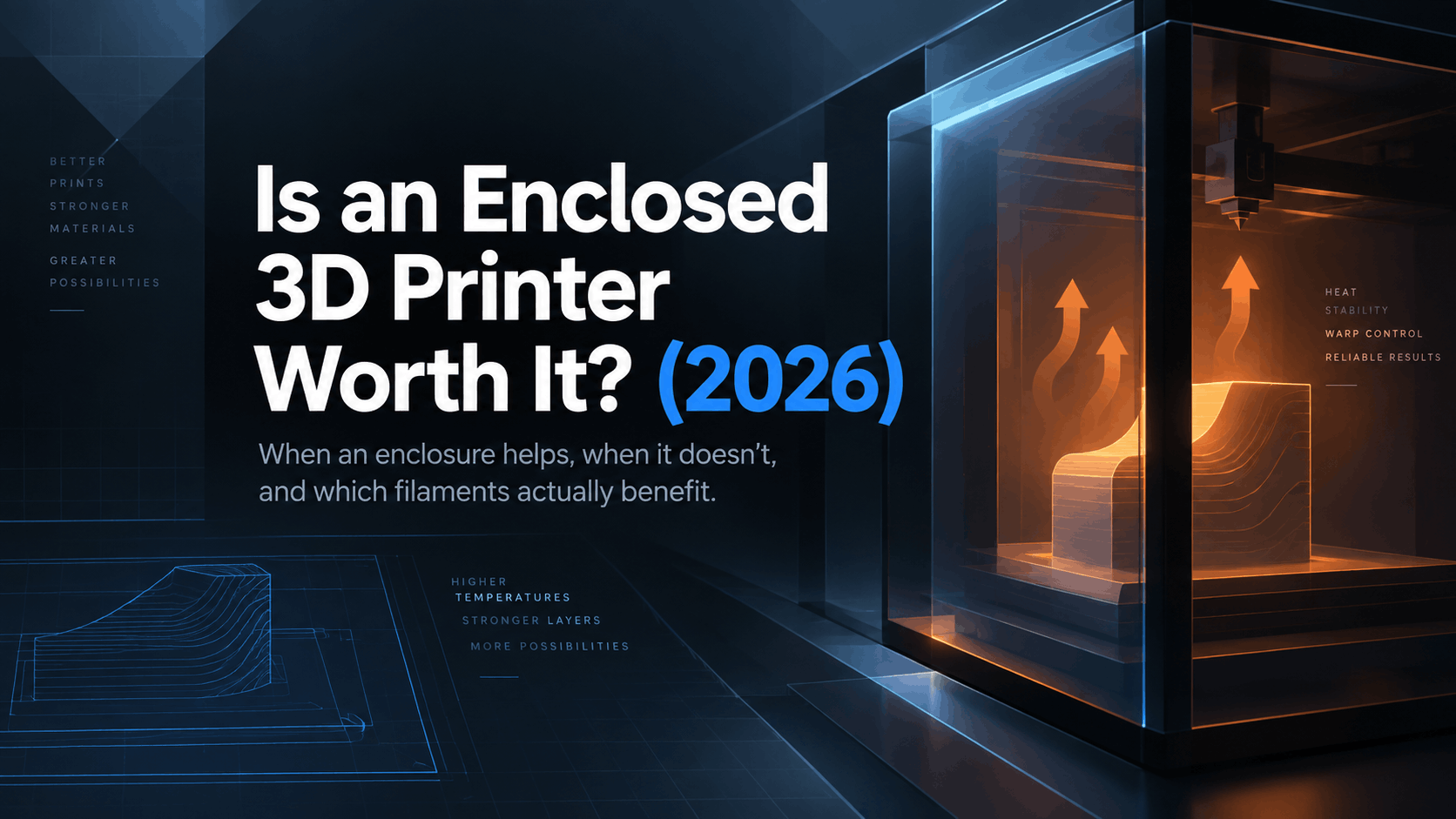
An enclosure buys you exactly one thing: the ability to print materials that warp. ABS, ASA, polycarbonate and nylon. That is the entire list.
It does not make PLA print better. It does not make prints stronger, faster, or more accurate. If you print PLA and PETG, which is most people most of the time, an enclosure is a box around a problem you do not have, and the money is better spent on filament.
So the question is not "is an enclosure good". It is "will I print warp-prone materials often enough to justify roughly doubling the price of the machine?"
What an enclosure actually does#
Warping is differential cooling. As a layer cools it contracts; if the layer beneath has already cooled and contracted more, the part curls away from the plate or splits along a layer line. ABS and ASA contract enough for this to happen on any print bigger than a few centimetres, in any room with a draught.
An enclosure holds ambient air warm so the whole part cools at a similar rate. That is all. It is passive: the printer's own bed and hotend supply the heat.
This is also why an enclosure is strongly recommended rather than strictly required for ABS and ASA in our material requirements: people do print ABS on open frames, in a warm room, with a draught shield, on small parts, with a lot of swearing. It works until the part gets big.
Nylon is the exception where we mark an enclosure required rather than recommended, and it needs dry filament just as badly.
Passive enclosure vs heated chamber#
These get conflated and they are not the same thing.
A passive enclosure traps whatever heat the machine produces. Ambient inside typically lands somewhere in the 35-50 °C range. That is plenty for ABS and ASA.
A heated chamber actively holds a set temperature. That is what polycarbonate and serious nylon work want, and it is rare. Across every printer in our database, exactly one consumer machine has one: the Anycubic Kobra S1 Max Combo. If heated-chamber materials are the actual goal, that single fact narrows your options more than any other spec on the page.
For everyone else, passive is the relevant question.
The honest cost comparison#
Open-frame machines start around $160-$250. Enclosed machines start around $300-$400 and climb from there. Current prices live on the Creality, Elegoo and Anycubic pages, because they move weekly and we check them daily. Trust those over any number written into an article.
The rough shape, though, is that an enclosure roughly doubles the entry price. Which means the real comparison is not "open vs enclosed". It is:
An enclosed printer, or an open-frame printer plus about 8-10 kg of filament?
Framed that way, most people should buy the filament. If you print PLA and PETG, that second option is straightforwardly more printing.
When it is genuinely worth it#
Buy the enclosure if any of these are true:
- Functional parts that live outdoors or in a car. ASA is UV-stable in a way PLA and PETG are not. A PLA bracket in a car window well is a puddle by August; this is the clearest case there is.
- Parts near heat. PLA softens around 55-60 °C. ABS and PC do not.
- You have already failed at ABS. If you have fought warping on an open frame and lost, you now know exactly what you are buying and why. That is the best possible reason.
- Noise or fumes matter. A side effect, but a real one. An enclosure muffles the machine noticeably, and ABS and ASA produce styrene fumes you want contained and vented.
Skip it if:
- You print display models, miniatures, prototypes, or anything indoors.
- You have never once wished a print was more heat-resistant.
- You are buying your first printer. Learn on PLA. You will know within six months whether you need more, and enclosed machines will be cheaper by then.
If you do buy enclosed, check the nozzle too#
Enclosure and hardened nozzle tend to arrive together at this tier, but not always. Anycubic's Kobra S1 Combo is enclosed at 320 °C with a standard nozzle; Creality's K1C is enclosed at 300 °C with a hardened one.
That matters because if you are stepping up to an enclosure for engineering materials, carbon-fibre blends are usually next, and those require a hardened nozzle, because abrasive fill destroys brass. Buying enclosed-but-soft means paying twice. The full gate-by-gate breakdown is in which 3D printer can print the filament you want.
The short version#
| You print... | Enclosure? |
|---|---|
| PLA, PETG | No. Buy filament instead. |
| Occasional small ABS parts | Probably not; a draught-free room gets you surprisingly far |
| ABS or ASA regularly, or anything outdoors | Yes |
| Carbon-fibre blends | Not required, but get a hardened nozzle |
| Nylon | Yes, plus a dryer |
| Polycarbonate, seriously | Yes, and look for a heated chamber |
Per-brand material support is on the compatibility pages for Creality, Elegoo and Anycubic. If you have decided and are just waiting on a price, current discount codes are on the deals page with the expiry date on each one.
Specs reflect manufacturer-published figures from our printer database. We earn a commission on purchases made through links on this site, at no additional cost to you.
Related Articles
Which 3D Printer Can Actually Print the Filament You Want? (2026)
Four hardware gates decide what a printer can run: enclosure, nozzle temperature, a hardened nozzle, and dry storage. Here is which current machines clear each one.
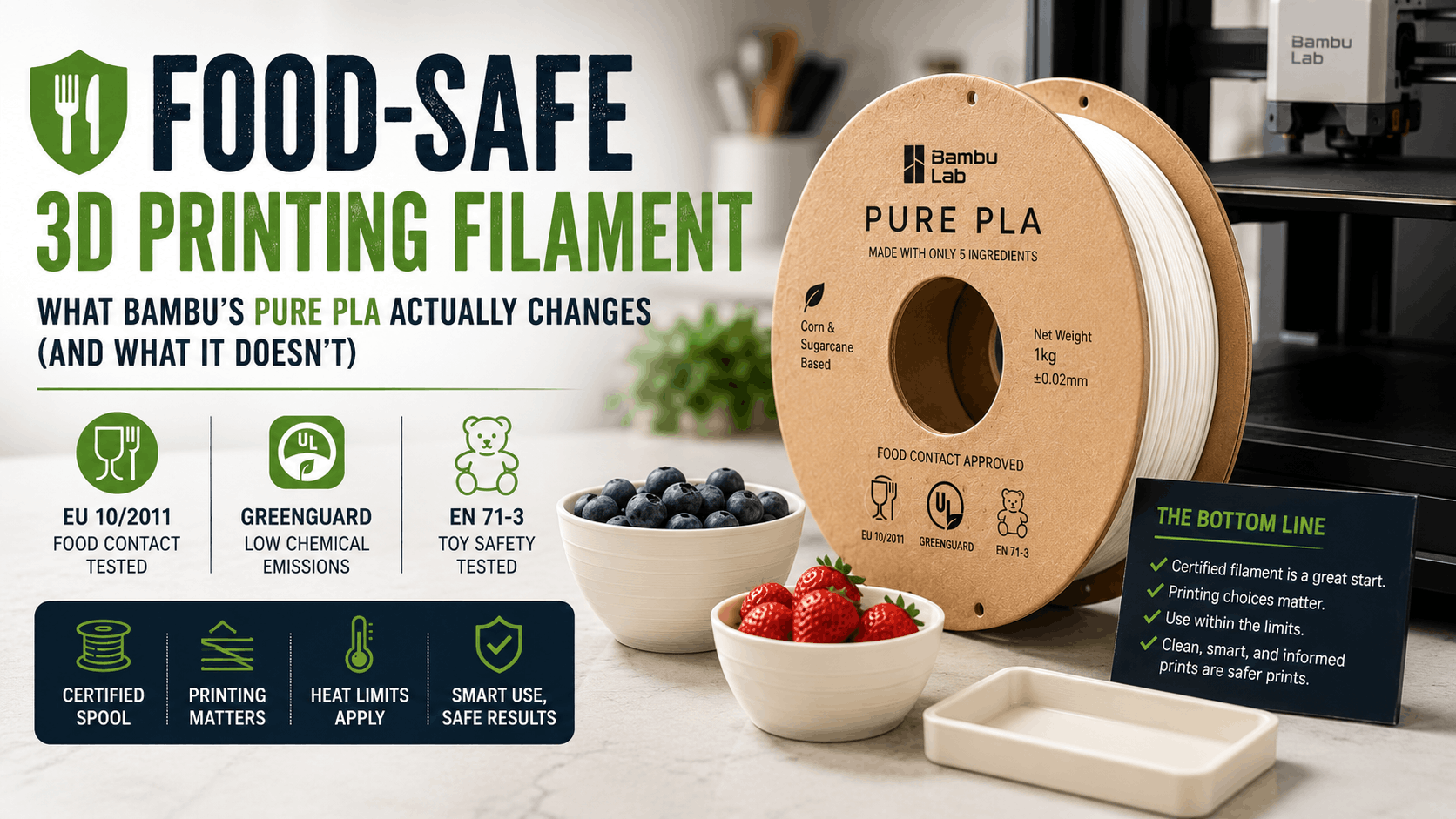
Is Bambu PLA Pure Food Safe? What the Certification Covers
Bambu PLA Pure is certified under EU 10/2011 for food contact, but that certifies the filament, not your printed part. What the certification covers, and where the real risk is.
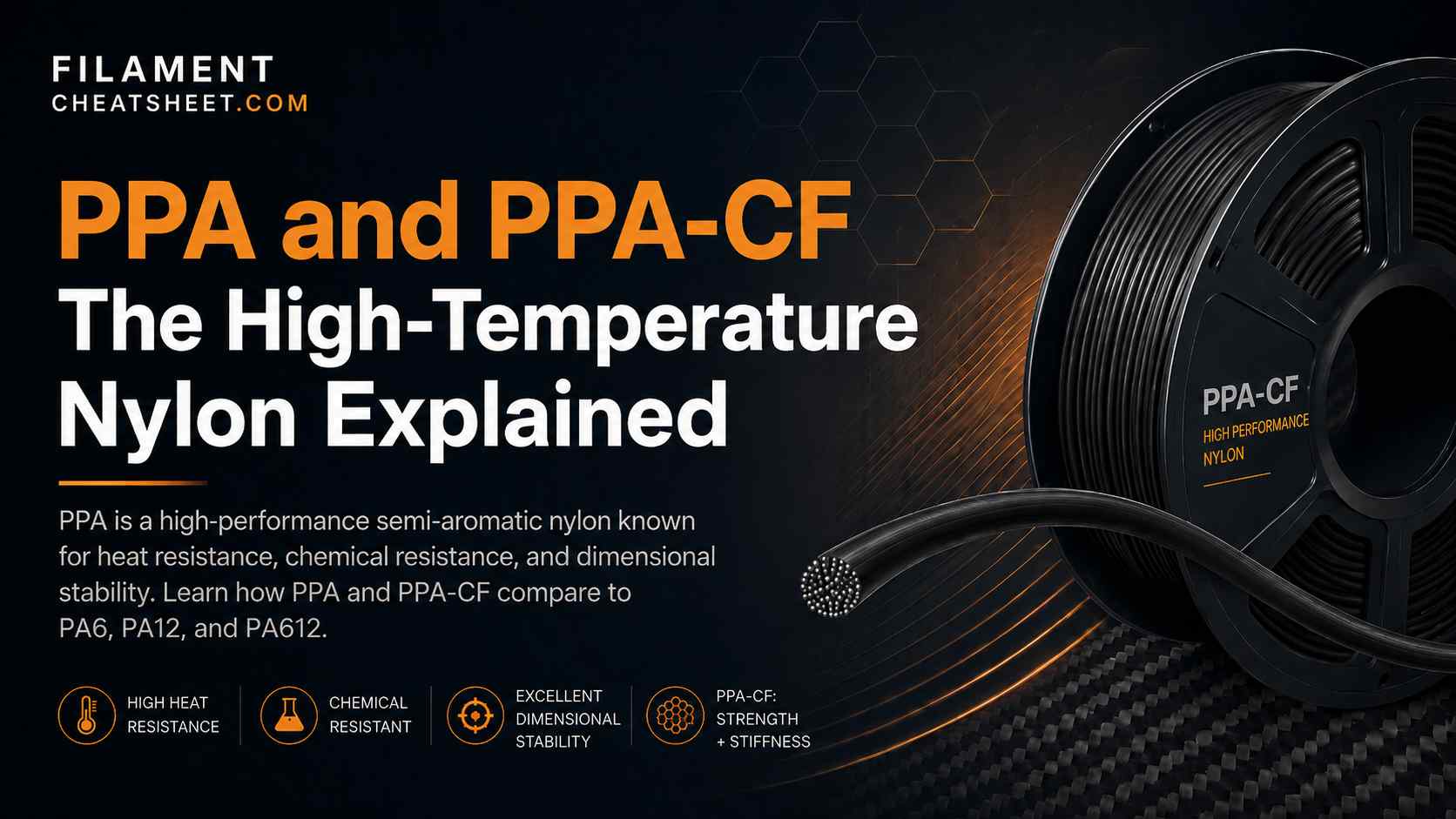
PPA and PPA-CF Filament: The High-Temperature Nylon Explained
PPA is a semi-aromatic nylon that outperforms PA6 on heat, chemicals and dimensional stability. A practical guide to PPA and PPA-CF, how they compare to PA6, PA12 and PA612, and what your printer needs.