Bambu PETG Matte: Specs, Settings, and Who Should Buy It
Bambu Lab's new PETG Matte costs the same as PETG Basic, undercuts PLA Matte, and promises PLA-like printing with supports that peel off by hand. The spec sheet, the settings, and the catches.
Josh Holtzclaw
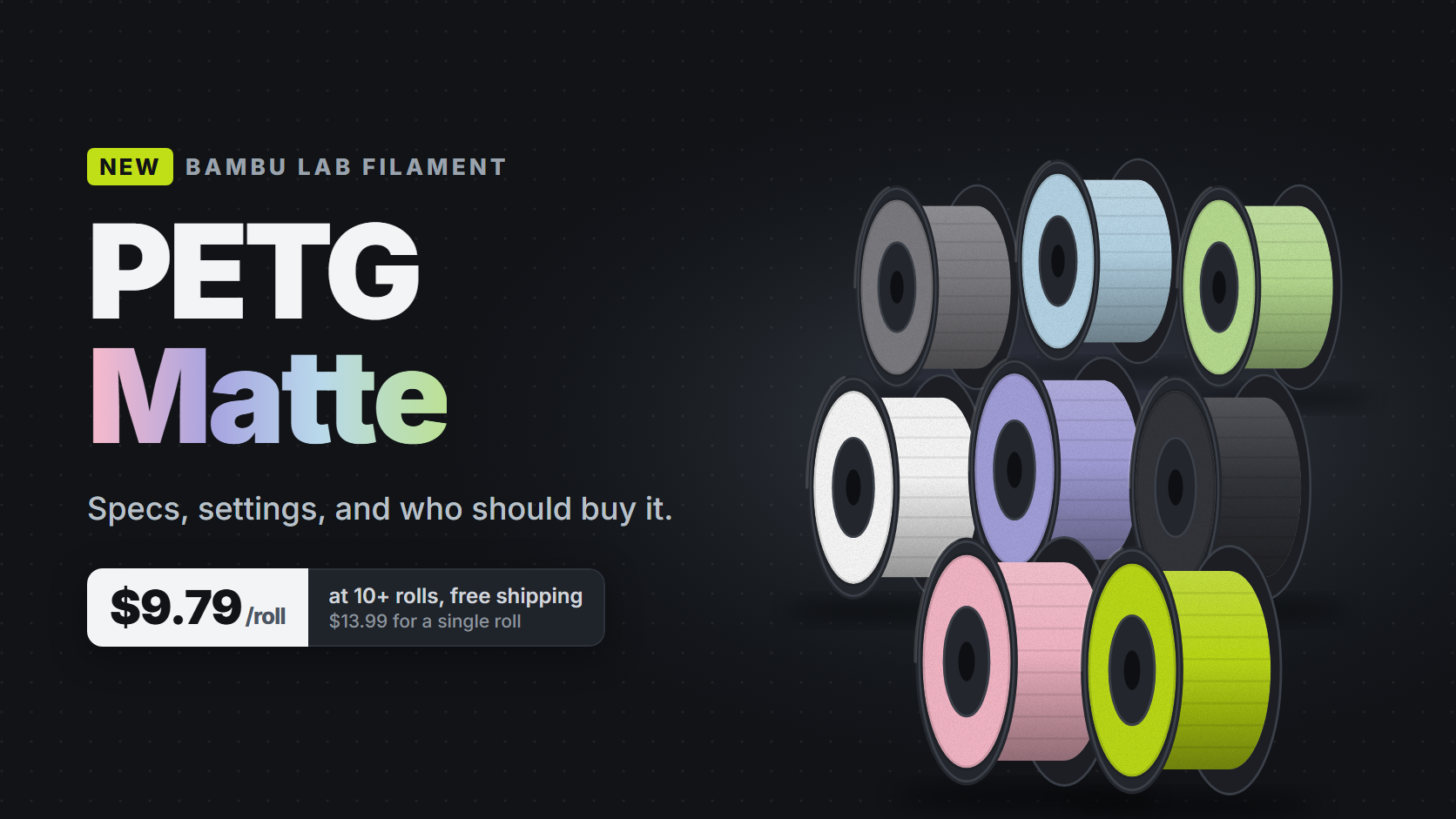
Bambu Lab has added a matte PETG to its lineup. The pitch on the product page is "Prints like PLA. Lasts like PETG," and the target is obvious: people who buy PLA Matte for decor and household parts, then find it softens in a hot car or cracks outside.
The part that got our attention is the price. PETG Matte is $13.99 for a 1 kg refill and $16.99 with a spool in the US store. That is the same as PETG Basic, and $2 less than PLA Matte ($15.99 refill, $18.99 with spool). A matte finish usually costs extra. Here it doesn't.
What Bambu Changed#
Bambu says the formula was reworked to fix four things people dislike about PETG:
- Finish. A soft, low-gloss surface that hides layer lines, instead of the usual PETG shine.
- Stringing and blobs. Less oozing on travel moves, including long prints with lots of travel between features.
- Supports. Same-material supports are meant to peel off by hand, even under steep overhangs. Anyone who has pried PETG supports off with pliers knows why this matters.
- Moisture. Better resistance to ambient humidity, so a spool stays printable for longer off the shelf.
It also carries UL GREENGUARD certification for low indoor emissions (the UL 2904 standard for FDM printing), the same certification Bambu uses on PLA Pure.
Colors#
There are 8 colors, each sold as a refill or on a spool. The store says "16 colors" because it counts both versions. Hex codes are from Bambu's color table:
| Color | Code | Hex |
|---|---|---|
| White | 35100 | #FFFFFF |
| Black | 35101 | #000000 |
| Gray | 35102 | #7F7E83 |
| Lime | 35500 | #C0DF16 |
| Avocado Green | 35501 | #BCE194 |
| Baby Blue | 35600 | #B9D9EB |
| Pink | 35700 | #FABBCB |
| Violet | 35702 | #A7A4E0 |
The palette is mostly pastels, which tells you who it's for: planters, lamps, bathroom organizers, and shelf decor, not black functional brackets.
Recommended Settings#
From Bambu's technical data sheet (TDS V1.0):
| Setting | Value |
|---|---|
| Nozzle temperature | 230 to 260°C |
| Bed temperature | 65 to 75°C |
| Build plate | Textured PEI, Smooth PEI, or Cool Plate SuperTack |
| Glue | Recommended (glue stick or liquid glue) |
| Print speed | Under 250 mm/s |
| Cooling fan | On |
| Retraction | 0.4 to 0.8 mm at 30 to 60 mm/s |
| Nozzle sizes | 0.2, 0.4, 0.6, 0.8 mm |
| Max overhang | About 70° |
| Max bridge | About 30 mm |
| AMS | AMS, AMS 2 Pro, AMS HT, AMS Lite |
Bambu's own test prints ran at 245°C nozzle, 70°C bed, and 221 mm/s on an H2 with a 0.4 mm hardened steel nozzle. On a Bambu printer with an AMS, the RFID tag loads the profile for you. On other printers, start at 245°C and 70°C and work from there.
The speed ceiling matters. At under 250 mm/s, this is not a replacement for the old PETG HF. If you were pushing PETG past 300 mm/s, look at the high-flow options in that post instead.
Strength and Heat#
PETG Matte is still PETG, and the numbers show it. Printed-part values from the TDS:
| Property | X-Y | Z (layer adhesion) |
|---|---|---|
| Tensile strength | 42.9 MPa | 30.1 MPa |
| Bending strength | 65 MPa | 47 MPa |
| Elongation at break | 13.8% | 6.5% |
| Impact strength | 32.6 kJ/m² | 10.0 kJ/m² |
Heat deflection is 71.2°C at 1.8 MPa and 72.3°C at 0.45 MPa, with a glass transition of 71°C. Standard PLA softens in the mid 50s, so this is the real reason to pick PETG Matte over PLA Matte for anything that lives in a car, a sunny window, or a hot garage. Density is 1.37 g/cm³, a bit heavier than typical PETG, so a 1 kg spool gives you slightly less volume.
Bambu lists it as resistant to most oils and grease, but not to acids, alkalis, or some organic solvents. It is not food grade.
The Catches#
It sticks hard to PEI. Bambu warns that PETG Matte bonds strongly to PEI plates and says to let the plate cool fully before removing parts, and it recommends glue. Skip the glue on smooth PEI and you risk pulling chunks out of the plate. This is standard PETG behavior, but Bambu calls it out specifically for this material.
It is not a support interface for PLA. The support formula that makes PETG Matte easy to peel from itself does not work as a PLA/PETG breakaway layer. For multi-material supports, Bambu says to use PETG Basic or its Support for PLA/PETG filament.
"Moisture resistant" still means drying. The fine print says to dry it after more than 72 hours at over 50% humidity. The same safety notes also call it "highly moisture-absorbent." In practice, treat it like any PETG: sealed box, desiccant, and dry before use. Bambu's drying settings:
- Oven: 65°C for 8 hours
- X, P, and H2 series heatbed: 80°C for 12 hours
- AMS 2 Pro or AMS HT: 60°C for 12 hours with filament loaded, 65°C for 8 hours without
Store it under 20% RH. Our filament drying and storage guide covers setups that hit that.
PETG Matte vs. PLA Matte vs. PETG Basic#
| PETG Matte | PLA Matte | PETG Basic | |
|---|---|---|---|
| Refill (1 kg) | $13.99 | $15.99 | $13.99 |
| With spool | $16.99 | $18.99 | $16.99 |
| Finish | Matte | Matte | Glossy |
| Heat resistance | ~71°C | Low (PLA) | PETG class |
| Colors | 8 | Much wider range | Much wider range |
| PLA support interface | No | n/a | Yes |
US store prices as of September 29, 2026.
Choose PETG Matte for parts that need to look good and survive heat, sun, or water: planters, outdoor mounts, bathroom and kitchen organizers (not food contact), car accessories, and lamp shades near warm bulbs.
Stay on PLA Matte if you need a color PETG Matte doesn't have, print fine detail on small figures, or want the easiest possible first layer and removal.
Stay on PETG Basic if you print in glossy colors, use it as a support interface for PLA, or just need functional parts where finish doesn't matter.
For a longer comparison between the two materials, see PLA vs PETG.
Where to Buy#
Bambu filament isn't sold through our Amazon links, so buy it direct from the Bambu Lab US store. It is part of the store's mix-and-match bulk pricing, and the quantity you buy matters more than the sticker price. A single refill is $13.99 plus $6.99 shipping, so $20.98 delivered. From there, per-roll refill prices in the US store drop like this:
| Rolls | Price per roll | Shipping per roll | Delivered per roll |
|---|---|---|---|
| 1 | $13.99 | $6.99 | $20.98 |
| 2 to 3 | $13.29 | $3.50 to $2.33 | $16.79 to $15.62 |
| 4 | $12.59 | $1.75 | $14.34 |
| 5 | $12.59 | Free | $12.59 |
| 6 to 9 | $11.89 | Free | $11.89 |
| 10+ | $9.79 | Free | $9.79 |
Shipping shown is to Alabama as of September 29, 2026. Rolls mix and match across Bambu filaments, so five rolls of anything gets you free shipping, and ten gets you the $9.79 price. Buying one roll at a time costs more than twice as much per roll as buying ten.
If you're buying refills, you need a Bambu reusable spool (or one you already have) to mount them.
Bottom Line#
- PETG Matte costs the same as PETG Basic and less than PLA Matte, so the matte finish is effectively free.
- Buy at least five rolls (any mix of Bambu filament) for free shipping, and ten for $9.79 a roll. One roll delivered is $20.98.
- It trades PLA's heat limit for ~71°C heat deflection with a finish that looks like PLA Matte.
- It tops out under 250 mm/s. It is not a PETG HF replacement.
- Use glue on PEI, let the plate cool before removal, and don't use it as a PLA support interface.
- Only 8 colors, mostly pastels. If yours is on the list, it is an easy pick over PLA Matte for anything that will see heat or weather.
Looking at other brands? Our best PETG filament brands ranked covers the alternatives, and the filament brand directory has the full list.
Related Articles
Bambu Lab Discontinued PETG HF: What to Use Instead in 2026
Bambu Lab quietly phased out PETG HF in most colors and replaced it with a reformulated PETG Basic. Here is what actually changed, why your old profile will not drop in cleanly, and the best high-speed PETG alternatives to switch to right now.
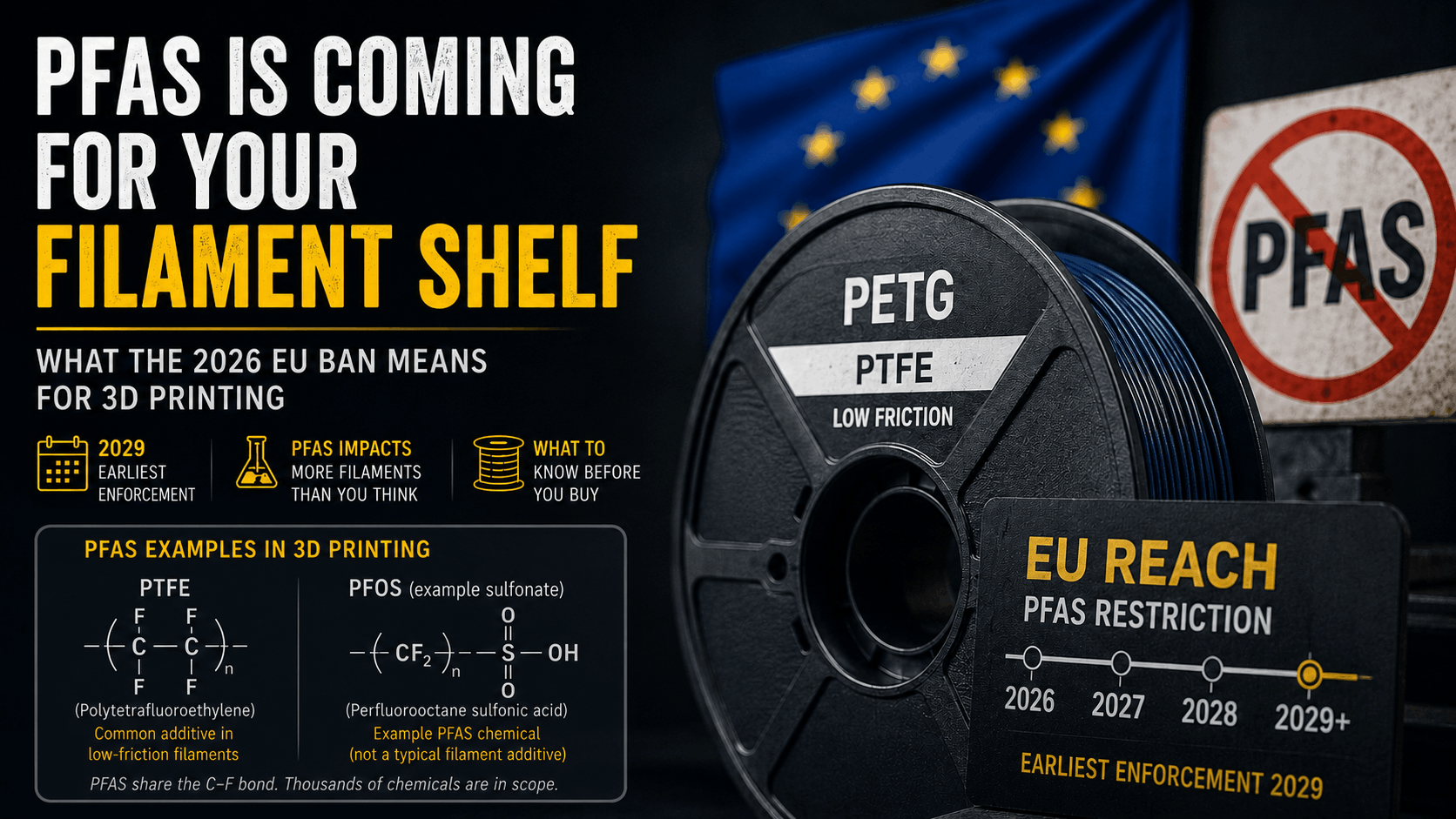
PFAS Is Coming for Your Filament Shelf: What the 2026 EU Ban Means for 3D Printing
The EU is finalizing the largest chemical restriction in its history, and it touches 3D printing filament more than most hobbyists realize. Here is what PFAS means for your spools, which materials are most at risk, and what to watch for through 2029.
Why Filament Prices Just Surged in 2026: Tariffs, Shortages, and How to Keep Printing Affordably
Filament prices jumped as much as 59% in 2026. Here is what is driving it (tariffs, supply crunches, TPU shortages) and the practical moves that keep your cost-per-print low.